
Homes near the coast in Los Angeles, from Malibu and Santa Monica to the South Bay beach cities, avoid the worst inland heat, but their roofs face a different set of problems: salt in the air, damp mornings under the marine layer, and steady ocean wind. Those conditions wear out metal parts, fasteners, and shaded slopes faster than the roofing itself.
This guide explains how ocean proximity affects roof life, which materials and fasteners hold up best on the coast, and what coastal roofing maintenance looks like.
What Salt Air Does to a Roof
- Corrosion of metal parts. Salt speeds up rust on steel flashing, drip edge, vents, gutters, and especially fasteners. A roof can fail at rusted nails and flashing while the shingles or tiles still look fine.
- Rust staining running down from vents and flashing.
- Dissimilar metals. Where different metals touch, such as copper and galvanized steel, salt moisture speeds up corrosion.
Fasteners and Flashing That Hold Up Near the Ocean
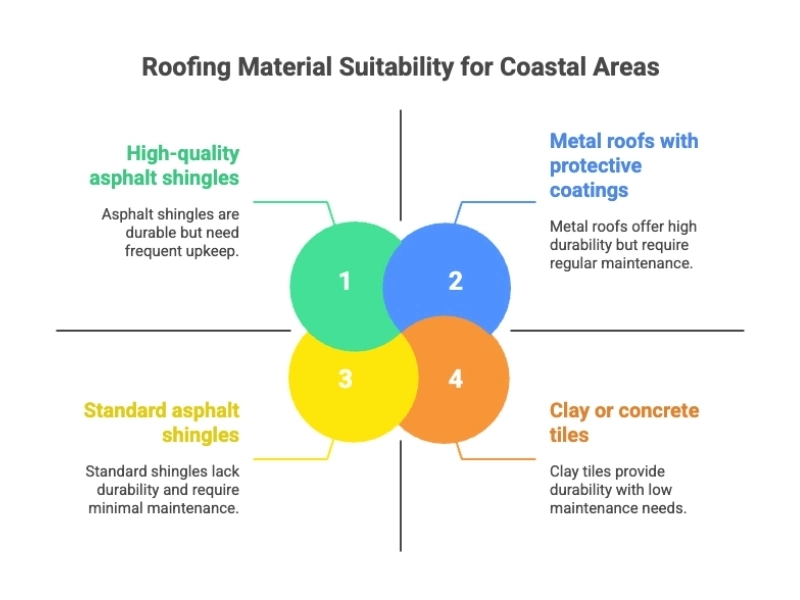
- Use stainless steel or hot-dip galvanized fasteners, not plain or electro-galvanized ones.
- Choose aluminum, copper, or stainless flashing and trim for homes close to the water, and keep metals compatible.
- On metal roofs, check the panel maker’s coastal limits: many metal roofing warranties limit coverage within a set distance of salt water. Aluminum panels are often chosen for oceanfront homes because aluminum does not rust.
- Rinse exposed metal parts with fresh water now and then, where it is safe to do so from the ground.
Marine Layer Moisture, Algae, and Moss
Morning fog keeps north-facing and shaded slopes damp for hours. That moisture feeds the dark streaks of algae on shingles and moss on shaded areas, which hold water against the roof. Algae-resistant shingles, which use copper-coated granules, help on the coast. Moss should be removed gently and the cause, shade and debris, addressed. Do not pressure-wash shingles or tile.
How Long Roofs Last Near the Coast
| Material | Estimated life (InterNACHI) | Coastal weak point |
|---|---|---|
| 3-tab shingles | About 20 years | Algae, wind, rusted nails |
| Architectural shingles | About 30 years | Algae on shaded slopes |
| Clay or concrete tile | 100 years or more for the tile | Underlayment and metal flashing under the tile |
| Metal | About 40 to 80 years | Corrosion at cut edges and fasteners; choose metals for the location |
On tile roofs, the tile usually outlasts what is under it, so coastal tile roofs are often lifted and relaid with new underlayment and corrosion-resistant flashing. See how long roofs last in California.
Cool Roof Rules on the Coast
Much of coastal Los Angeles is in climate zone 6. There, Title 24’s cool roof requirement for steep-slope home reroofs does not apply, because that rule covers zones 4 and 8 through 15. The low-slope rule does apply in zone 6: when more than half of a low-slope home roof is replaced, the new surface generally needs an aged solar reflectance of at least 0.63 and a thermal emittance of at least 0.75. Check your address, since climate zone lines do not follow city limits.
Coastal Roof Maintenance Checklist
- Have the roof inspected once a year, with attention to fasteners, flashing, vents, and gutters.
- Replace rusted vents, flashing, and drip edge before rust spreads.
- Clear moss and debris from shaded slopes and valleys.
- Check for lifted shingles and loose ridge caps after strong winds.
- Keep gutters clear and check them for rust-through.
We work along the coast, including Santa Monica, Malibu, Hermosa Beach, and El Segundo.
Coastal Roofing Questions
What is the best roof for a house near the beach?
Tile and well-chosen metal, such as aluminum, hold up well on the coast, as do algae-resistant architectural shingles. Whatever the roofing, stainless or hot-dip galvanized fasteners and corrosion-resistant flashing matter most.
Does salt air damage roofs?
Yes. Salt speeds up corrosion of fasteners, flashing, vents, and gutters, and a roof can fail at those metal parts while the roofing still looks fine.
How long does a roof last near the ocean in Los Angeles?
The roofing itself can reach its normal life, but metal parts and underlayment often need attention sooner. Annual inspections and corrosion-resistant materials help the whole roof last.
Do I need a cool roof on the coast?
Much of coastal Los Angeles is in climate zone 6, where the steep-slope cool roof rule does not apply but the low-slope rule does. Check your address.
Why is there dark streaking on my coastal roof?
Usually algae, fed by marine layer moisture on shaded slopes. Algae-resistant shingles help, and gentle cleaning removes it; pressure-washing damages the roof.
Overhead Roofing inspects, repairs, and replaces roofs in coastal neighborhoods across Los Angeles County, with offices in Pasadena and Tarzana. Call (877) 557-7778 to schedule a roof inspection and get a written estimate.


