
Overhead Roofing » Flat Roofing
Flat Roof Contractors in Los Angeles
Torch-down, TPO, built-up, and coated flat roofs for homes, room additions, garages, and commercial buildings across Los Angeles County. Estimates are free.
- Licensed, bonded & insured
- CSLB #1119699 (C-39)
- BBB Accredited, A rating
Flat Roofing Contractors Serving LA County
Flat roof contractors in Los Angeles work on low-slope roofs: the nearly flat roofs on mid-century homes, room additions, garages, patio covers, apartment buildings, and many commercial buildings. Overhead Roofing works on torch-down modified bitumen, TPO, built-up, and coated flat roofs, and this page explains how those systems differ, what a sound flat roof job includes, and which of our services fits your roof.
Overhead Roofing is licensed, bonded, and insured under CSLB #1119699 (C-39 Roofing). Estimates are free, and we base them on what we find on the roof.
Overhead Roofing is a Polyglass Premio Select Contractor (#9272) and an ASC Certified Contractor for silicone roof coatings.
Pitch under 2:12
Standing 48+ hours after rain
Free and written
CSLB #1119699 (C-39)
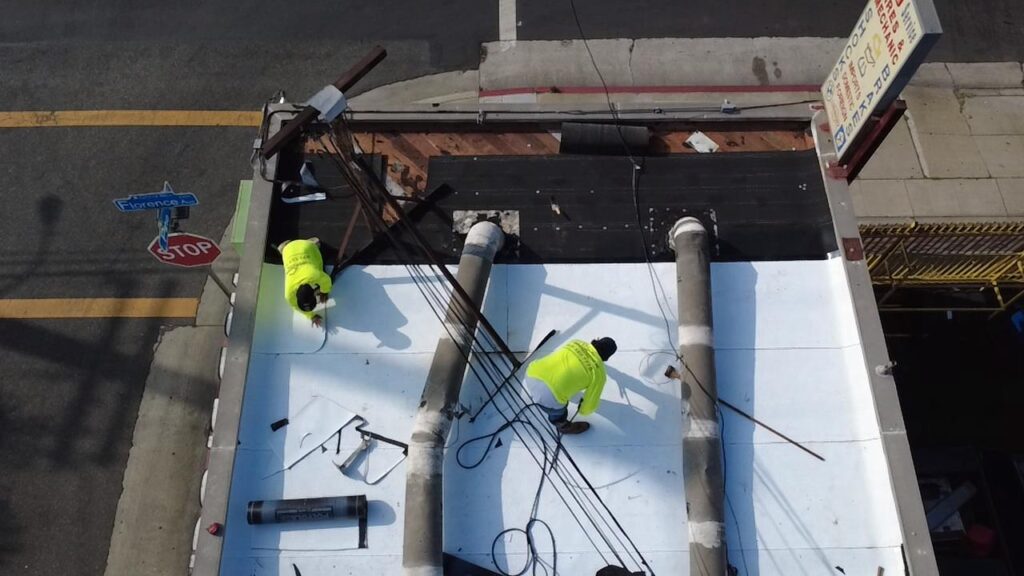
What Counts as a Flat Roof, and Why It Still Needs Slope
A flat roof is a low-slope roof. California’s energy code defines low-sloped as a pitch of less than 2 inches of rise per 12 inches of run (2:12). No flat roof should be truly level. It needs enough slope to carry water to a drain, a scupper, or a gutter, because water left on a roof finds every weak seam.
Roofers call it ponding when water is still standing on a roof 48 hours after rain in drying weather, which is how the National Roofing Contractors Association defines it. Ponding points to low spots, a sagging deck, or clogged drains, and it wears out most roof surfaces faster.
Water leaves a flat roof in one of three ways:
- Roof drains set into the roof, common on commercial buildings with parapets
- Scuppers, openings through a parapet wall that empty into a downspout
- Gutters along an open roof edge, common on homes, garages, and patio covers
When a roof does not drain, a contractor can add slope with tapered insulation or build a cricket, a small raised section that turns water toward a drain. Both are far easier to add when a roof is being replaced than at any other time.

Flat Roofing Systems Used on Los Angeles Homes and Buildings
You will find four main systems on Los Angeles flat roofs.
Torch-down modified bitumen with a cap sheet
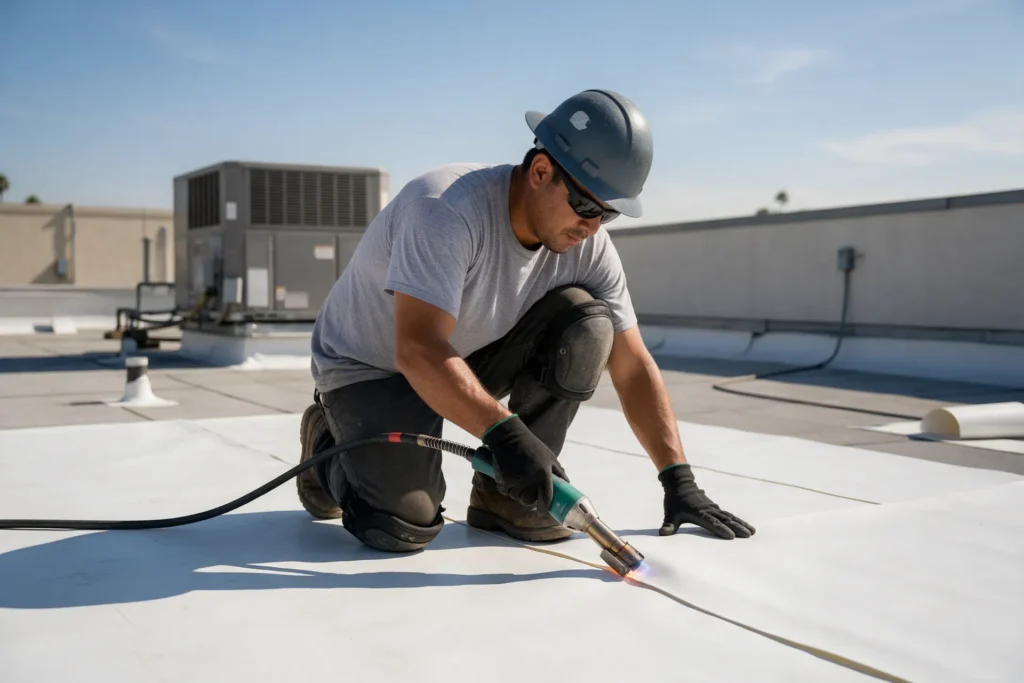
Modified bitumen is asphalt blended with polymers and made into rolls. On a torch-down roof, the roofer heats the back of each roll with a propane torch so it bonds to the layer below. The top layer is a cap sheet surfaced with mineral granules, often white or light gray to reflect the sun. It takes foot traffic, it is easy to patch, and it handles the many small details on homes and smaller buildings well. Our flat roof work in Bell and Pomona used torch-down with a cap sheet. Where a roof meets wood siding or other combustible trim, a self-adhered modified bitumen sheet can be used instead of a torch.
TPO single-ply
TPO is a single layer of white membrane, fastened or glued over insulation board, with seams melted together by hot air. It suits larger, simpler roofs. It is thinner than a torch-down roof, so areas with foot traffic need walkway pads. Our TPO roofing page covers the system in detail.
Built-up roofing
A built-up roof (BUR) is made of several layers of roofing felt set in hot asphalt and finished with gravel or a cap sheet. Many older buildings still have one. It can often be repaired, but it is heavy, and tearing it off is slow, messy work. When a built-up roof wears out, it is usually replaced with modified bitumen or TPO.
Roof coatings
A coating is a liquid layer, usually acrylic or silicone, rolled or sprayed over an existing roof. It renews the surface and can make it reflective, but it does not fix wet insulation, a soft deck, or poor drainage. Silicone holds up better than acrylic where water collects. A coating only makes sense on a roof that is still sound underneath.
Call our 24/7 line. We offer fast response, with same-day visits when crews are available.
Flat Roofs on Homes vs. Commercial and Apartment Buildings
Residential flat roofs are common in Los Angeles on mid-century and modern homes, room additions, garages, carports, and patio covers. Their weak points differ from a commercial roof’s:
- Stucco walls. Where a flat roof meets a taller stucco wall, the membrane turns up the wall and is covered by counterflashing or a stucco stop. Cracked stucco above that joint lets water in behind the roof.
- Additions and patio covers. A flat section tied into a sloped roof creates a joint between two roof types, and that joint needs its own flashing.
- Edges and gutters. Many homes drain to a gutter along one edge, so a sagging edge or a clogged gutter backs water up onto the roof.
Commercial and apartment flat roofs are larger, usually have parapets, roof drains, and rooftop HVAC units, and come with tenants and business hours to plan around. Those jobs fall under our commercial roofing service, linked with the related services below.
The cool roof rules also differ by building type. For a house, the 2025 California Energy Code calls for a cool roof surface when more than half of a low-slope roof is replaced in climate zones 4 and 6 through 15. Those zones take in most of Los Angeles County, and the City of Los Angeles also applies its own rule in every zone. The values, the exceptions, and the separate rules for apartment and commercial buildings are in our guide to California cool roof requirements.
What Flat Roof Contractors Should Check Before Quoting
A flat roof quote should come after someone has been on the roof and looked past the surface. Before pricing the job, a flat roofing contractor should:
- Trace how water leaves the roof, and mark low spots, clogged drains, and blocked scuppers
- Count the existing layers and check whether the insulation or deck is wet, usually with a small test cut
- Inspect every parapet, coping joint, and wall where the roof meets stucco or siding
- Check each penetration: pipes, vents, skylights, HVAC curbs, and conduit
- Look for soft or sagging decking from below where it can be reached
- Tell you whether the job needs a building permit and whether the cool roof rule applies
Those checks decide whether a roof can be repaired, covered with a new layer, or has to come off. Before you hire, look the contractor up on the CSLB license lookup and confirm an active license with the C-39 Roofing classification. Ours is CSLB #1119699 (C-39).
Which Flat Roof Service Fits Your Roof
Once you know the condition of the roof, the next step is usually one of these:
- A leak, an open seam, a blister, or loose flashing on a roof that is otherwise sound calls for flat roof repair.
- A worn surface over dry insulation may be a candidate for a roof coating.
- Repeated leaks, wet insulation, or ponding you cannot drain point to flat roof replacement.
- A new addition, garage, patio cover, or building needs flat roof installation.
- A large, simple roof that needs a white single-ply surface is a good fit for TPO.
If you are not sure which one you need, we will tell you after we see the roof, and the estimate is free.
Our Reviews
Posted on GoogleTrustindex verifies that the original source of the review is Google. I live in Alhambra and had a few broken tiles after a windstorm. William and Mike from Overhead Roofing Inc came highly recommended, and now I know why. They handled the repairs quickly and thoroughly, and even checked nearby spots without being asked. Sherry from the office made billing and follow-up a breeze. I’ll be using them again for a full re-roof in the futurePosted on GoogleTrustindex verifies that the original source of the review is Google. Great, thank youPosted on GoogleTrustindex verifies that the original source of the review is Google. Our office in Sierra Madre started having ceiling leaks. Overhead Roofing Inc sent Sean and Mike, who discovered the issue was actually with the parapet wall flashing. They fixed it and gave us solid maintenance recommendations. Tammi kept everything on time and within budget. Their knowledge and clarity made a huge difference.
Get an Estimate for Your Flat Roof
Send us a few details about the roof: the building, the roof system, and any leaks or ponding you have seen. Call (877) 557-7778 or use the form below. Overhead Roofing is licensed, bonded, and insured (CSLB #1119699, C-39), and estimates are free.
Get Your Free Estimate
Please fill out the form below, or call: (877) 557-7778
Please fill out the form below, or call:
(877) 557-7778
Need Roof Repair or Replacement? Get a Free Estimate Today!
Don’t wait until a minor issue turns into a significant expense. At Overhead Roofing CA, we make it easy to get expert service fast with no pressure and no hidden fees. From routine roof maintenance to full tear-offs and installations, our team handles every project with precision, honesty, and care.
We specialize in helping LA homeowners and business owners protect their most valuable assets with dependable roofing solutions that last. Our licensed contractors are standing by, ready to inspect your roof, answer your questions, and provide a clear action plan all at no cost to you.
Residential roof repair & replacement
Commercial roofing inspections & upgrades
Emergency leak response & storm damage repair
Financing options available for every budget
Questions About Flat Roofing in Los Angeles
What does a flat roof specialist in Los Angeles do differently?
Flat roofs use different materials and methods than shingle or tile roofs: torch-applied and self-adhered modified bitumen, hot-air welded TPO seams, tapered insulation, crickets, and the flashing details at parapets, scuppers, and stucco walls. A flat roof specialist should know all of them and the Title 24 cool roof rules for low-slope roofs, and should be able to explain why a roof is ponding before recommending a fix.
Is torch-down or TPO better for a flat roof on a house?
On many homes, torch-down modified bitumen with a cap sheet is the practical choice. It takes foot traffic, patches easily, and handles small roofs with many vents, walls, and edges. TPO suits larger, simpler roofs and gives a bright white surface. If your reroof triggers the cool roof rule, either one has to be a CRRC-rated product that meets it, so ask for the rating.
Can a flat roof be used as a deck or patio?
Yes, if it is built for it. A standard roof membrane is not made for furniture, planters, and daily foot traffic. A roof deck needs a walkable waterproof surface, such as a deck coating system or a membrane protected by pavers. The framing also has to carry the added load, which can mean an engineer and a building permit. If you are planning one, tell us early so the roof and the deck surface are designed together.
How do I compare quotes from flat roofing companies in Los Angeles?
Put the scopes side by side, not just the totals. Check whether each quote includes a full tear-off or a layer over the old roof, new or tapered insulation, new flashings and edge metal, and drain and scupper work. Also look for the named roof product and its CRRC rating, the permit, and a written workmanship warranty. Flat roof contractors who leave those lines out are often pricing a different job.
Do you work on flat roofs outside the City of Los Angeles?
Yes. We work across Los Angeles County and also serve Orange and Ventura counties. The permit comes from wherever the building sits: LADBS in the City of Los Angeles, the city’s own building department in other cities, and Los Angeles County Public Works in unincorporated areas and its contract cities. The cool roof rule depends on the climate zone, which our county pages list by area.
Serving All of Southern California
Choose your county to see the cities and roofing services near you.