
Overhead Roofing » Metal Roof Replacement
Metal Roof Replacement in Los Angeles
New panels, trim, and fasteners for worn metal roofs on homes, garages, and commercial buildings, from a licensed C-39 roofer. Estimates are free.
- Licensed, bonded & insured
- CSLB #1119699 (C-39)
- BBB Accredited, A rating
Replacing an Old Metal Roof in Los Angeles County
Metal roof replacement is for a building that already has a metal roof at the end of its life: panels rusting through, screws that keep leaking, or laps that open every rainy season. We replace old corrugated, ribbed, and standing seam roofs on Los Angeles County homes, garages, workshops, and commercial buildings, either with new panels of the same type or with an upgrade to standing seam.
A metal roof that has failed in one or two places can often be repaired, and our metal roof repair page covers that work. Replacement makes sense when the problems are spread across the roof or the metal itself is wearing out. We check the panels, fasteners, trim, and the deck or framing under them, then send you photos of what we find along with a free written estimate.
If your house has shingles or tile today and you are thinking about switching to metal, that is a first-time install. Our metal roof installation page covers those choices, from standing seam to stone-coated steel.
CSLB #1119699 (C-39)
3 in 12 min. without sealant
Class A if 50%+ replaced
Accredited, A rating
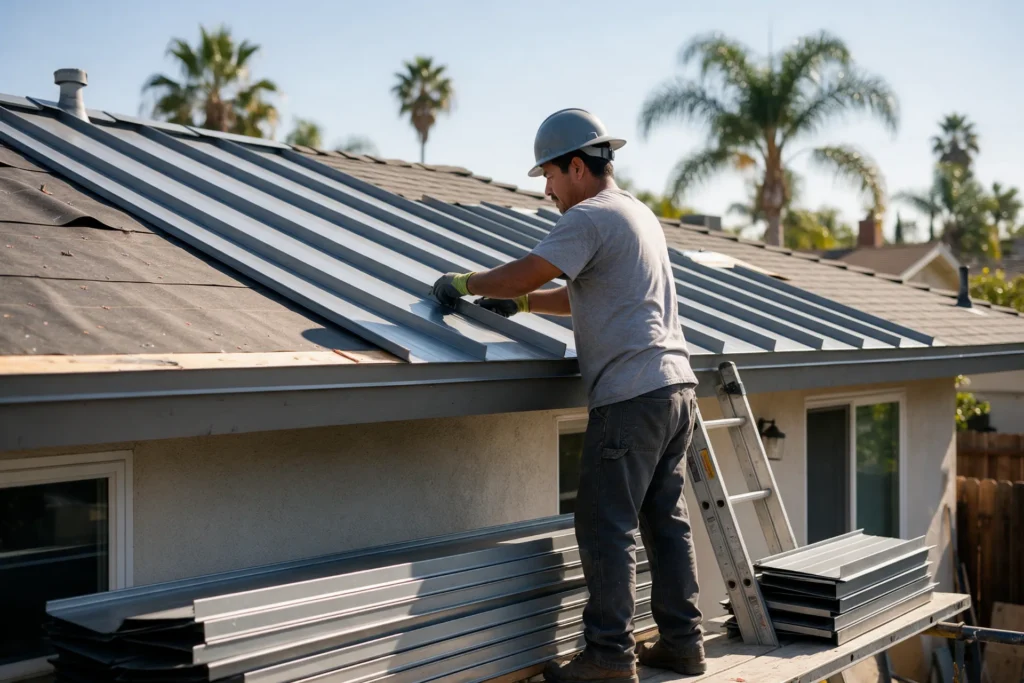
Signs a Metal Roof Needs Replacement, Not Another Repair
Any one of these can be repaired on its own. When several show up across the roof, replacement is usually the better use of your money.
Rust that has eaten through the panels
Surface rust on a coated steel panel can be cleaned and treated. Once rust has made holes or thin spots, especially along the bottom edges of panels and at overlaps where water sits, the metal has lost its thickness, and patches tend to move the leak to the next weak spot. On older roofs, the rust often starts at the screws and spreads into the panel.
Screw holes that won't stay sealed
Exposed-fastener roofs depend on hundreds or thousands of screws with rubber or plastic washers. The washers age in the sun, and heat cycles work the screws back and forth until the holes grow. New screws one size larger fix a few spots, but when the holes are oversized across the whole roof, new panels are the lasting fix.
Laps that leak on a low-slope roof
Older garage and shop roofs often have lapped panels on a low pitch. California’s code calls for at least 3 in 12 of slope for lapped panels without sealant, or sealed laps on slopes down to 1/2 in 12. A low roof built without sealed laps keeps leaking at the overlaps, and a replacement lets us switch to a system that suits the pitch.
Damage from wind, trees, or foot traffic
Bent ribs, crushed panels, and torn trim from a Santa Ana wind event, a fallen limb, or years of foot traffic can be fixed panel by panel when the rest of the roof is sound. On an older roof, an exact match for the profile and color is often no longer available, which pushes the decision toward replacement.
Rusted trim, flashing, and gutters
Edge trim, ridge caps, and flashing often wear out before the panels do. When a roof is replaced, California’s code requires existing flashings, edgings, vents, and similar parts to be replaced if they are rusted, damaged, or deteriorated, so new trim is normally part of a metal roof replacement.
Corrugated and Exposed-Fastener Metal Roof Replacement
Corrugated and ribbed roofs, often called tin roofs, are common on garages, carports, barns, workshops, and older commercial buildings in Los Angeles County. The panels are screwed through their face into wood purlins, a deck, or steel framing. When one of these roofs is replaced, there are three main options:
| Replacement option | Good fit for | Keep in mind |
|---|---|---|
| New exposed-fastener panels in the same profile | Garages, carports, and shops with enough pitch | Keeps the look and usually the framing; new screws still need periodic checks |
| Standing seam panels | Homes, ADUs, and low slopes down to 1/4 in 12 | Fasteners hidden under the seams; may need a different deck and trim |
| A new metal system over the old roof (a retrofit) | Commercial and industrial buildings with sound framing | Allowed without tear-off when it carries its loads straight to the structure |
Code references: California Residential Code R905.10 and California Building Code 1512.3 (2025 editions).
Some panels are made to span open purlins, and others need a continuous deck, so the manufacturer’s details decide whether sheathing goes on first. Corrugated metal roof replacement on a garage or carport is usually like for like, while on a home or ADU it is worth pricing standing seam as well.
Call (877) 557-7778 any time, or use the form below. Office hours are Sunday through Friday, 8 a.m. to 5 p.m.
Replacing a Few Metal Roof Panels or the Whole Roof
Metal roof panel replacement, where only the damaged panels come out, works when the problem is local and the rest of the roof has life left. The new panel has to match the old profile closely enough to lap and seal, and the screws or clips around it are replaced too. New paint will not match faded panels, so we tell you before the work how close the match will be.
Replacing the whole roof is the better choice when rust, loose fasteners, or open laps show up across several slopes. It also lets us fix what is underneath: rotted purlins or sheathing, missing underlayment on a house, and gutters or trim that have rusted out.
In a fire hazard severity zone covered by the Wildland-Urban Interface Code, a reroof that replaces half or more of the roof covering within 12 months has to meet the Wildland-Urban Interface Code’s rules for new construction, including a Class A roof assembly. Smaller repairs must still be Class A.
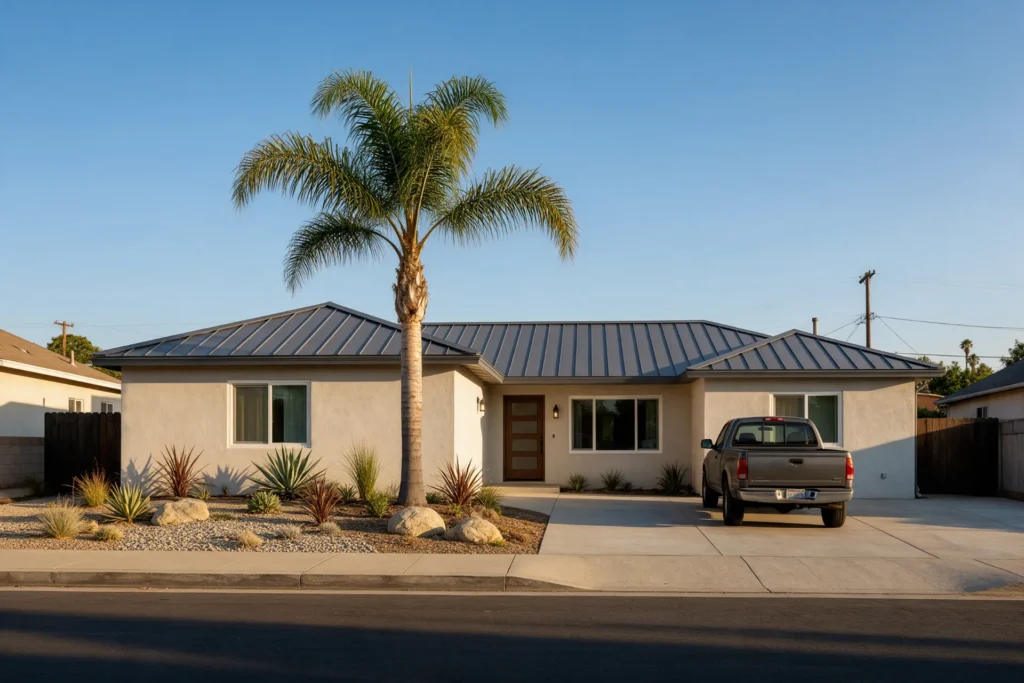
Metal Roof Replacement on Garages, Shops, and Commercial Buildings
Many of the metal roofs we replace sit on buildings other than the main house. For property owners and facility managers planning a commercial metal roof replacement, these points shape the job:
- Recover or tear-off. The California Building Code allows a new metal roof over an old one without tear-off when it is a complete, separate system that carries its loads straight to the building’s structure, such as standing seam on new framing.
- Cool roof rules. On a conditioned nonresidential building, the Title 24 cool roof rule comes into play when more than half the roof area, or over 2,000 square feet if that is the smaller figure, is replaced. Work on the roof of an unconditioned building does not, as the Energy Commission’s summary explains.
- Tenants and operations. Panel removal is loud, so work areas, hours, and parking are set with the owner or manager in advance, and opened areas are kept small enough to close up before the crew leaves.
- Skylights, vents, and equipment. Old translucent skylight panels, exhaust fans, and pipe penetrations are replaced or reflashed along with the new roof.
For low-slope membrane roofs, parapets, and drains on the rest of the building, see our commercial roofing page.
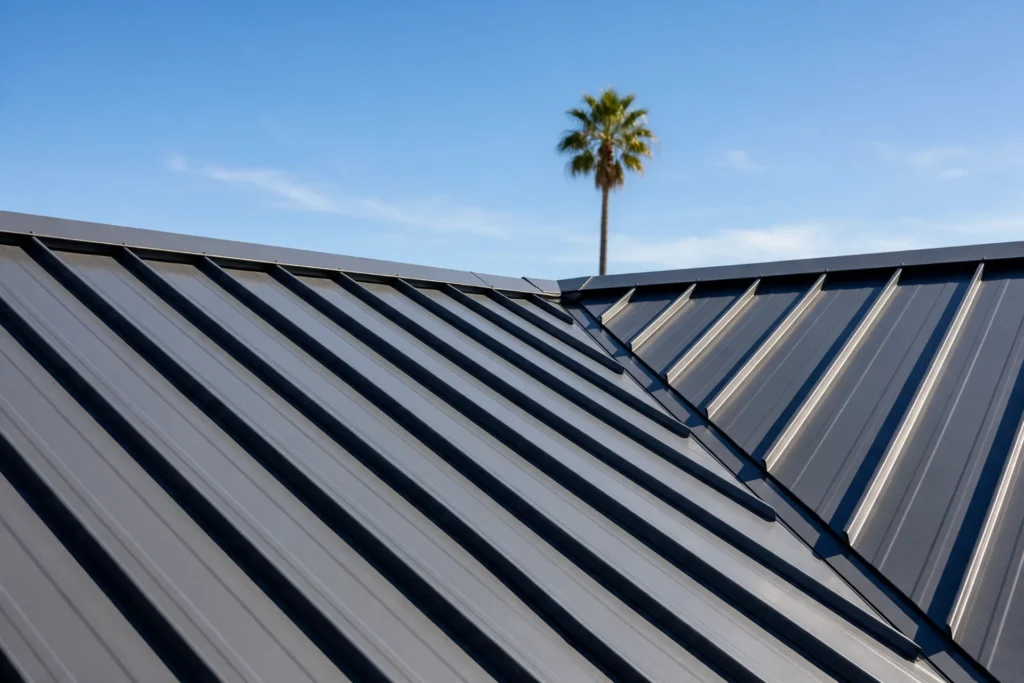
From Tear-Off to Final Inspection
- Inspection and estimate. We check the panels, fasteners, trim, and structure, and note what can stay.
- Permit. We pull the permit, from LADBS inside Los Angeles city limits or from your own city’s building department elsewhere.
- Removal. Old panels, trim, and fasteners come off in sections, each small enough to be made watertight by the end of the day.
- Structure and deck. Rotted purlins or sheathing are replaced, and sheathing is added if the new system calls for it.
- Underlayment and flashing. Where there is a roof deck, underlayment and new flashing go on first.
- Panels and trim. Panels, closures, ridge cap, and edge trim go on to the manufacturer’s details, with new fasteners throughout.
- Final inspection. The inspector signs off the permit, and you get the permit record and our workmanship warranty.
Price depends on the roof area and pitch, the panel system and finish, what is under the old roof, how much framing or sheathing needs repair, skylights and other penetrations, access, and any fire zone or cool roof requirements. Estimates are free and written. Our roof replacement cost guide gathers published Southern California price ranges, each with its source.
Our Reviews
Posted on GoogleTrustindex verifies that the original source of the review is Google. I live in Alhambra and had a few broken tiles after a windstorm. William and Mike from Overhead Roofing Inc came highly recommended, and now I know why. They handled the repairs quickly and thoroughly, and even checked nearby spots without being asked. Sherry from the office made billing and follow-up a breeze. I’ll be using them again for a full re-roof in the futurePosted on GoogleTrustindex verifies that the original source of the review is Google. Great, thank youPosted on GoogleTrustindex verifies that the original source of the review is Google. Our office in Sierra Madre started having ceiling leaks. Overhead Roofing Inc sent Sean and Mike, who discovered the issue was actually with the parapet wall flashing. They fixed it and gave us solid maintenance recommendations. Tammi kept everything on time and within budget. Their knowledge and clarity made a huge difference.
Price Your Metal Roof Replacement
Send us the address, the type of building, and a few photos of the roof and any leaks, or call (877) 557-7778. We will check the panels, fasteners, and framing and give you a free written estimate. We are licensed, bonded and insured under CSLB #1119699.
Get Your Free Estimate
Please fill out the form below, or call: (877) 557-7778
Please fill out the form below, or call:
(877) 557-7778
Need Roof Repair or Replacement? Get a Free Estimate Today!
Don’t wait until a minor issue turns into a significant expense. At Overhead Roofing CA, we make it easy to get expert service fast with no pressure and no hidden fees. From routine roof maintenance to full tear-offs and installations, our team handles every project with precision, honesty, and care.
We specialize in helping LA homeowners and business owners protect their most valuable assets with dependable roofing solutions that last. Our licensed contractors are standing by, ready to inspect your roof, answer your questions, and provide a clear action plan all at no cost to you.
Residential roof repair & replacement
Commercial roofing inspections & upgrades
Emergency leak response & storm damage repair
Financing options available for every budget
Metal Roof Replacement Questions
How much does metal roof replacement cost?
We don’t list prices, because two metal roofs of the same size can vary widely. The panel system, roof pitch, what has to come off, framing or deck repairs, trim and flashing, and access all drive the price. We give a free written estimate for your roof, and the cost guide linked above collects published Southern California figures from named sources.
Can I replace just a few metal roof panels?
Yes, if the damage is limited and a matching panel is available. The new panel needs the same profile so it laps and seals with the panels around it, and the screws or clips nearby are replaced too. Expect a color difference on an older, faded roof. If rust or loose screws are spread across the roof, replacing panels one at a time rarely ends the leaks.
Can a new metal roof go over the old metal roof?
On some commercial and industrial buildings, yes. The California Building Code allows a complete, separate system, such as standing seam on new framing, to go over the old roof without tear-off when it carries its loads straight to the building’s structure. On homes and garages we normally remove the old panels so we can check the deck or purlins underneath.
Do I need a permit to replace a metal roof?
Yes. Replacing a metal roof is a reroof, and it needs a permit: LADBS issues it inside the City of Los Angeles, each city’s building department issues it elsewhere, and LA County Public Works handles unincorporated communities. Commercial reroofs can also bring Title 24 cool roof paperwork, and roofs in fire hazard zones must meet Class A requirements. We obtain the permit and arrange the inspections.
Does the cool roof rule apply to a metal warehouse or shop roof?
Not if the building is unconditioned. The Energy Commission says alterations to the roof of an unconditioned building do not trigger the nonresidential cool roof rule. On a conditioned commercial building, the rule applies once the reroof passes the size threshold in the section above (half the roof or 2,000 square feet, whichever is less), and a low-slope roof then needs a CRRC-rated cool surface.
Serving All of Southern California
Choose your county to see the cities and roofing services near you.