
Overhead Roofing » Storm Damage Roof Repair
Storm Damage Roof Repair in Los Angeles
Repairs after winter rainstorms, Santa Ana winds, and falling branches, with photos and a written estimate you can send to your insurer. Estimates are free.
- Licensed, bonded & insured
- CSLB #1119699 (C-39)
- BBB Accredited, A rating
Roof Repair After Rain, Wind, and Falling Trees
Storm damage roof repair in Los Angeles usually follows one of three events: a winter rainstorm, a Santa Ana wind event, or a tree or branch coming down on the roof. We inspect the roof for free, photograph the damage, and give you a written report and estimate you can send to your insurance company.
If water is coming inside right now, call (877) 557-7778, day or night, or see our emergency roof repair page. If the storm has passed, the sections below explain what it may have done to your roof and what your insurer will want to see.
Free, with photos and report
November to March
Most common Oct. to March
CSLB #1119699 (C-39)
The Storms That Damage Roofs in Los Angeles
Winter rainstorms and atmospheric rivers
In downtown Los Angeles, about 87% of normal yearly rainfall (12.4 of 14.25 inches) falls from November through March, based on NOAA climate normals for 1991 to 2020. The heaviest storms are often atmospheric rivers, long bands of moisture that can bring heavy rain for hours or days. When storms come back to back, the roof and decking have no time to dry out between them.
Santa Ana wind events
Santa Ana winds carry dry air from the interior deserts toward the coast. They are most common from October through March and pick up speed as they funnel through passes and canyons. Wind creases and lifts shingles, breaks the sealant bond that holds them flat, loosens ridge cap and hip tiles, and peels back the edges of flat roofs. Damage from a dry wind event often stays hidden until the next rain, so schedule any wind damage roof repair before the rainy season if you can.
Falling trees and branches
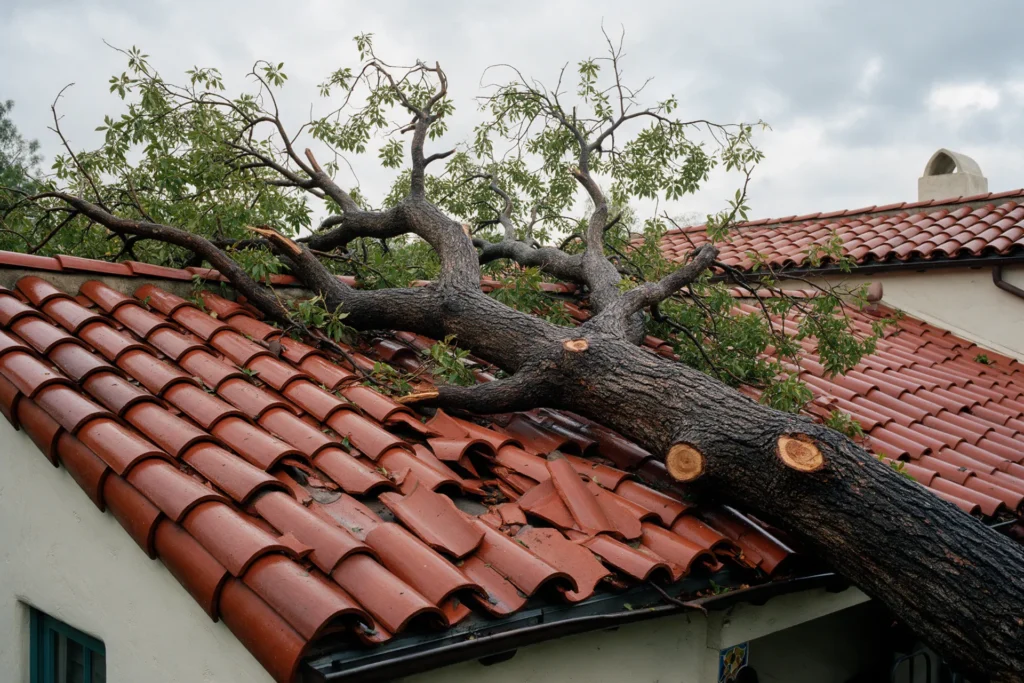
Wind breaks limbs, and long rains soften the ground around tree roots. A falling branch can crack tile, puncture shingles and decking, and bend gutters. Even a branch that only scrapes across the roof can loosen tiles or tear flashing.
Hail is uncommon here
Hail large enough to damage roofing is uncommon in the Los Angeles basin, so we do not sell hail repair as a separate service.
Call our 24/7 line. We offer fast response, with same-day visits when crews are available.
Signs of Wind and Water Damage on Shingle, Tile, and Flat Roofs
What we look for depends on the type of roof:
| Roof type | Wind damage | Water damage |
|---|---|---|
| Asphalt shingle | Creased, lifted, or missing shingles; loose ridge cap | Leaks at pipe boots, step flashing, and valleys; soft decking at the eaves |
| Clay or concrete tile | Slipped, cracked, or broken tiles; loose hip and ridge tiles | Water reaching worn underlayment; leaks at chimneys, valleys, and headwalls |
| Flat or low-slope | Lifted membrane edges, open seams, loose coping or edge metal | Ponding water at clogged drains and scuppers; leaks at parapets and curbs |
Tile roofs need a closer look than you can get from the street. On a clay or concrete tile roof, the tile sheds most of the water, but the underlayment beneath it is the waterproof layer. A slipped or broken tile leaves that underlayment open to sun and rain, and worn underlayment can leak with every tile still in place. On a clay tile repair in Walnut, the work covered the tile and new flashing around the chimney, a frequent weak point on tile roofs.
From the ground, look for pieces of shingle or tile in the yard, debris piled in roof valleys, and gutters pulled away from the fascia. Do not climb onto a roof after a storm.
What We Check in a Free Storm Damage Roof Inspection
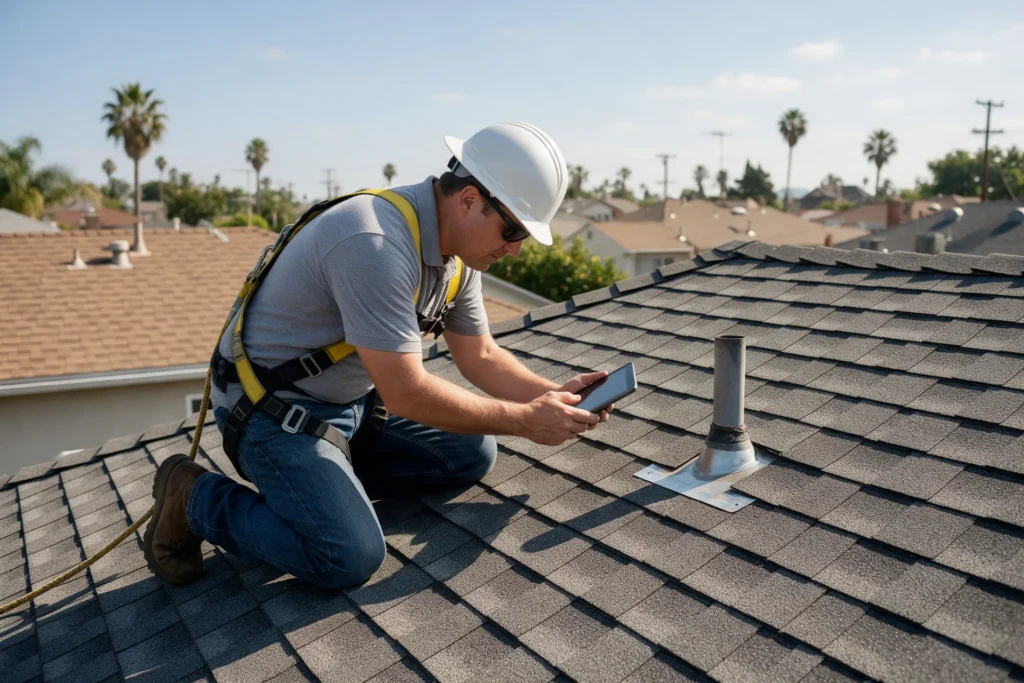
A storm damage roof inspection is free. When the roof is safe and dry enough to walk, a roofer goes over it slope by slope, checks the areas below any leak, and records what the storm did. We check:
- The roof covering: shingles, tiles, or membrane
- Flashing at walls, chimneys, valleys, and skylights
- Pipe boots, vents, ridge cap, and drip edge
- Gutters, downspouts, roof drains, and scuppers
- The attic or the ceiling below any leak, where we can reach it
You get photos of each damaged area, a written roof inspection report that describes the damage, and a written repair estimate. The report also notes wear that was there before the storm, such as aged underlayment or old patches, because your adjuster will look for it too.
Roof Insurance Claim Steps for Homeowners
You file and manage the claim with your insurance company. These are the steps the California Department of Insurance (CDI) recommends after storm damage:
- Read your policy. Ask your insurer for a complete copy, including the declarations page; it must send one free within 30 days of your request. Check your deductible, because the insurer is not obligated to pay for damage that costs less than the deductible.
- Report the claim. Write down the claim number and the adjuster’s name, and keep notes on every conversation.
- Document the damage. Photograph the roof from the ground, the inside of the house, and any damaged belongings before you clean up, and keep damaged items until the adjuster says they can go.
- Prevent further damage. Make reasonable temporary repairs, such as tarping or sealing the roof, and keep every receipt. CDI warns about contractors who push expensive temporary repairs and advises waiting on permanent repairs until the adjuster has seen the damage.
- Get a written estimate. CDI recommends at least one repair estimate to compare with your coverage limits and the insurer’s estimate. Our report and estimate are written so you can send them to your insurer.
CDI’s Residential Property Claims Guide and its tips for people affected by winter storms cover these steps in more detail. The CDI consumer hotline is 800-927-4357.
How long your insurer has to respond
California’s Fair Claims Settlement Practices Regulations set deadlines for insurers. These are the main ones for a roof claim:
| The insurer must | Deadline | Rule |
|---|---|---|
| Acknowledge your claim | 15 calendar days after notice | 10 CCR 2695.5(e) |
| Accept or deny it, in whole or in part | 40 calendar days after proof of claim | 10 CCR 2695.7(b) |
| Explain in writing if it needs more time | Updates every 30 days | 10 CCR 2695.7(c) |
| Pay an accepted claim | 30 days after acceptance | 10 CCR 2695.7(h) |
Source: California Department of Insurance, Guide for Adjusting Property Claims in California After a Major Disaster (2026), citing Title 10 of the California Code of Regulations.
What we do on a claim, and what we don’t. We document the damage with photos, give you a written inspection report and estimate to send to your insurer, and can meet the adjuster at your home if you ask. We do not file, negotiate, or settle claims. If you want someone to represent you, CDI licenses public adjusters, and you can also hire a lawyer.
For a longer walk-through, read our guide on how to handle a roof insurance claim step by step. If your roof is older, see whether insurance will cover a 20-year-old roof in California.
Repair or Replace After Storm Damage
Storm damage is often repairable. A typical repair replaces missing shingles or ridge cap, resets slipped tiles and replaces broken ones, reseals or replaces flashing, or patches a damaged section of flat roof membrane. Replacement starts to make sense when:
- The damage covers several slopes instead of one area
- The decking is soaked or delaminated across a large section
- The shingles are so brittle that repairs crack the shingles around them
- The existing shingle is discontinued, so new pieces will not match
Tile roofs have a middle option: a tile reset, where the tiles come off, new underlayment goes down, and the same tiles go back on. We reset a clay tile roof this way in San Marino. On shingle roofs, a tear-off can also uncover problems the storm did not cause. Our shingle replacement in Whittier, for example, included new plywood decking.
In the City of Los Angeles, a reroof needs an LADBS permit, and if more than half of a roof is reroofed within one year, the entire roof must be brought up to current code. Other cities have their own building departments and rules. Whatever your insurer decides about the claim, the choice to repair or replace is yours, and we can price both options when both make sense.
Our Reviews
Posted on GoogleTrustindex verifies that the original source of the review is Google. I live in Alhambra and had a few broken tiles after a windstorm. William and Mike from Overhead Roofing Inc came highly recommended, and now I know why. They handled the repairs quickly and thoroughly, and even checked nearby spots without being asked. Sherry from the office made billing and follow-up a breeze. I’ll be using them again for a full re-roof in the futurePosted on GoogleTrustindex verifies that the original source of the review is Google. Great, thank youPosted on GoogleTrustindex verifies that the original source of the review is Google. Our office in Sierra Madre started having ceiling leaks. Overhead Roofing Inc sent Sean and Mike, who discovered the issue was actually with the parapet wall flashing. They fixed it and gave us solid maintenance recommendations. Tammi kept everything on time and within budget. Their knowledge and clarity made a huge difference.
Get a Storm Damage Roof Estimate
Tell us when the storm hit, what you can see from the ground, and whether water is coming inside. Call (877) 557-7778 or use the form below. Overhead Roofing is licensed, bonded, and insured (CSLB #1119699, C-39), and estimates are free.
Get Your Free Estimate
Please fill out the form below, or call: (877) 557-7778
Please fill out the form below, or call:
(877) 557-7778
Need Roof Repair or Replacement? Get a Free Estimate Today!
Don’t wait until a minor issue turns into a significant expense. At Overhead Roofing CA, we make it easy to get expert service fast with no pressure and no hidden fees. From routine roof maintenance to full tear-offs and installations, our team handles every project with precision, honesty, and care.
We specialize in helping LA homeowners and business owners protect their most valuable assets with dependable roofing solutions that last. Our licensed contractors are standing by, ready to inspect your roof, answer your questions, and provide a clear action plan all at no cost to you.
Residential roof repair & replacement
Commercial roofing inspections & upgrades
Emergency leak response & storm damage repair
Financing options available for every budget
Storm Damage and Insurance Claim Questions
How can I tell if my roof has storm damage if I can't see anything from the ground?
Check inside first. New ceiling stains, peeling paint near the ceiling, or damp attic insulation all point to water getting in. A tile roof can leak with no visible damage, because the underlayment under the tile does the waterproofing. A free storm damage roof inspection answers the question with photos and a written report.
Will my homeowners insurance pay for storm damage to my roof?
Only your policy and your insurer can answer that, and we do not make coverage decisions or predictions. Read your policy and declarations page, check your deductible, and report the claim. What we can give you is the evidence: photos, a written report that separates storm damage from older wear, and a repair estimate for your insurer.
Can a roofing contractor handle my insurance claim for me?
No. A roofing contractor can document the damage and price the repair, but the claim is between you and your insurer. If you want someone to represent you, the California Department of Insurance licenses public adjusters, and you can also hire a lawyer. We can meet your adjuster at the property if you ask.
Do you repair hail damage?
We repair the damage we find, but hail large enough to damage roofing is uncommon in the Los Angeles basin. If a door-to-door crew says otherwise, ask for photos, check its license with the CSLB, and know that California limits the down payment on most home improvement contracts to $1,000 or 10% of the contract price, whichever is less.
How soon after a storm should I get my roof inspected?
As soon as the weather allows, and before the next storm if you can. Your policy may set a deadline for reporting a loss, so check it. A small opening left by one storm can let in much more water during the next, and an early inspection gives you photos taken close to the date of the damage.
Serving All of Southern California
Choose your county to see the cities and roofing services near you.