
Overhead Roofing » Emergency Roof Tarping
Emergency Roof Tarping and Temporary Sealing in Los Angeles
Call our 24/7 line, (877) 557-7778, for a tarp or temporary seal; we offer fast response, with same-day visits when crews are available. Estimates are free.
- Licensed, bonded & insured
- CSLB #1119699 (C-39)
- BBB Accredited, A rating
Temporary Roof Repair Until the Permanent Fix
Emergency roof tarping covers a damaged section of roof with heavy, reinforced plastic sheeting held down by wood strips, so rain stays out until the permanent repair is made. Temporary sealing does the same job for smaller openings, such as a cracked pipe boot or a split flashing joint. We do both on shingle, tile, metal, and flat roofs in Los Angeles, Orange, and Ventura counties.
Our roof tarp service is a stopgap. A tarp or temporary seal keeps water off the decking, the insulation, and the rooms below while the roof dries and the permanent repair is planned. It does not fix the damage.
If water is coming in right now, call (877) 557-7778; the line is answered 24/7. For a tree on the roof or a sagging ceiling, see emergency roof repair. To have a leak traced and fixed for good, see roof leak repair.
24/7: (877) 557-7778
November to March
30 days (USACE)
CSLB #1119699 (C-39)
Tarp or Temporary Roof Seal: What the Damage Needs
The size of the opening decides which one we use:
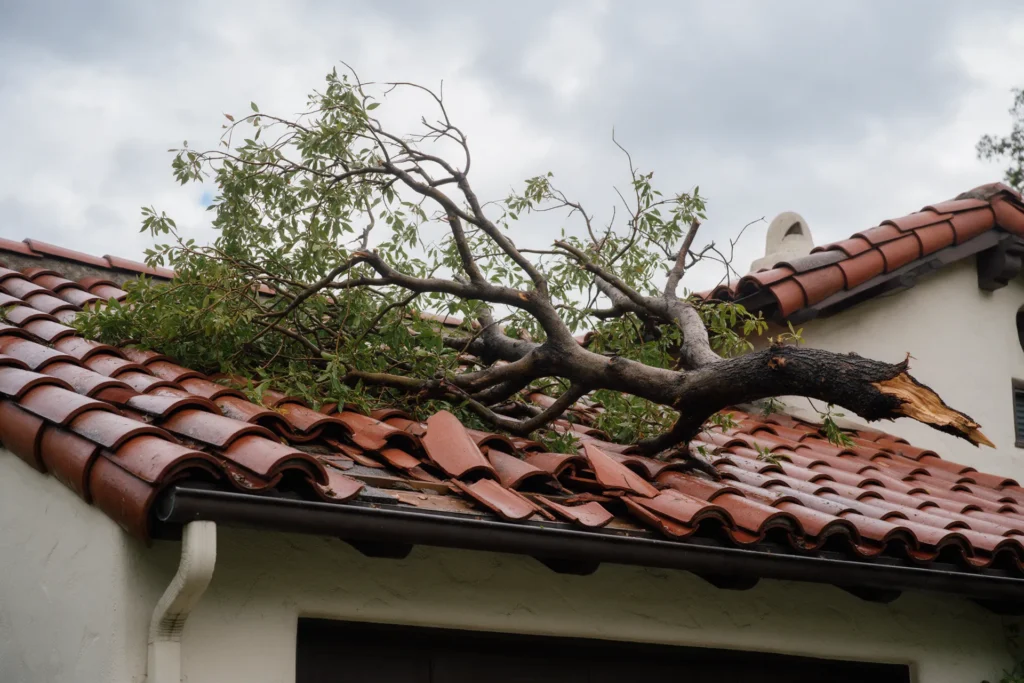
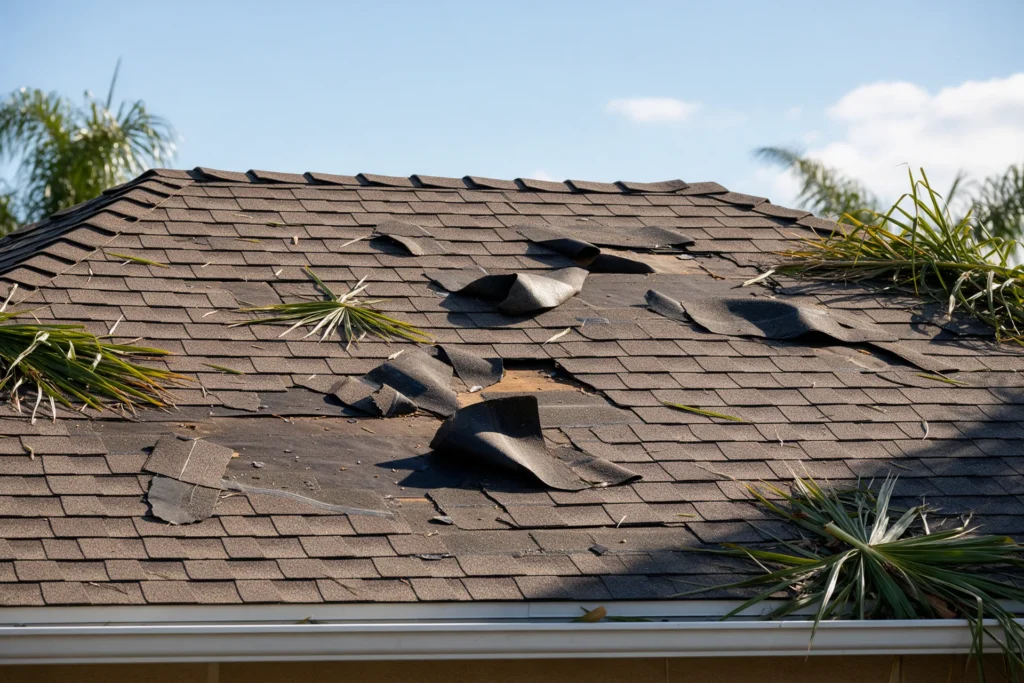
- A tarp covers a hole from a fallen branch, shingles or tiles torn off by wind, or any area too large or too broken to seal.
- A temporary seal closes a cracked pipe boot, a lifted shingle, a split in step or chimney flashing, an open seam on a flat roof, or a small puncture.
Temporary roof sealing uses a roofing sealant or a membrane patch. Sealant on a flashing joint cracks and pulls away as the roof heats and cools, so the failed part still has to be replaced. A clay tile repair we did in Walnut, for example, included new flashing around the chimney.
Tarping waits when the roof itself is the hazard: lightning, wind strong enough to tear the sheeting loose, or decking that may not hold a person. A tree on the roof usually has to be removed by a tree service first.
Emergency Roof Tarping on Shingle, Tile, Metal, and Flat Roofs
The method depends on the roof covering.
Asphalt shingle roofs
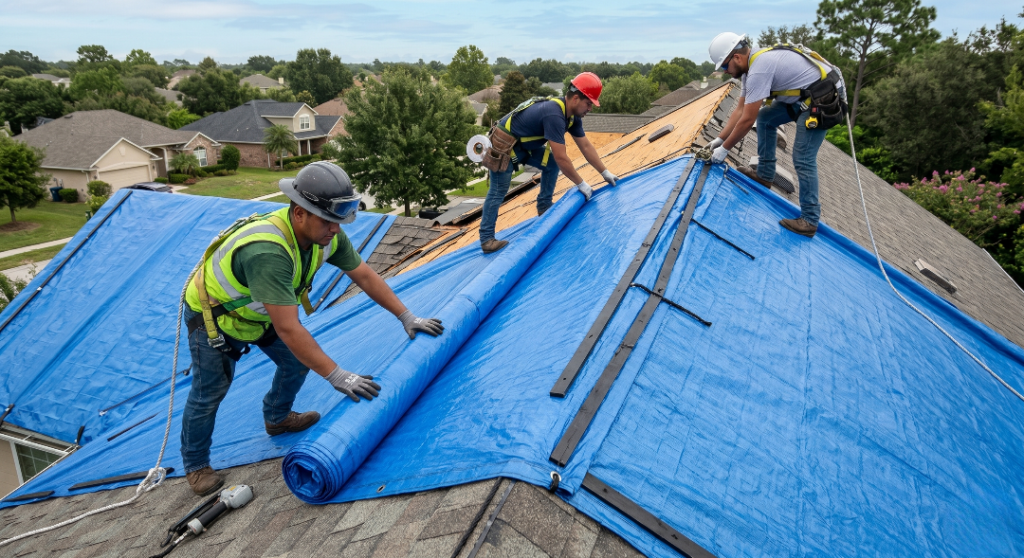
The tarp runs from below the damage up and over the ridge, so water from the upper slope flows across it instead of under it. Wood strips are screwed through the tarp edges into the roof deck. We place them where the permanent repair will replace shingles anyway, so new roofing covers the holes.
Clay and concrete tile roofs
Tile cracks under foot traffic and under screws, so the crew steps only where tiles are supported and avoids fastening through sound tile. Broken pieces come off first, and tiles we remove are saved for reuse. The underlayment beneath the tile is what keeps water out, so the goal is to keep rain off any spot where it is torn or exposed.
Metal roofs
Bent or torn panel edges are flattened or trimmed first, because sharp metal can cut the sheeting in the first strong wind. Every new screw through a sound panel is a possible leak, so we fasten the tarp where panels or trim will be replaced during the permanent repair.
Flat and low-slope roofs
A flat roof tarp collects water, and the weight of that pond can pull it loose. On low-slope roofs we usually seal instead: clear the roof drains and scuppers, then patch the open seam, blister, or puncture. A large opening gets a tarp fastened with wood strips, and that tarp should be checked after each rain. Our flat roof repair page covers the permanent fix.
Call our 24/7 line. We offer fast response, with same-day visits when crews are available.
Roof Tarp Installation: Fastening It So It Stays Down
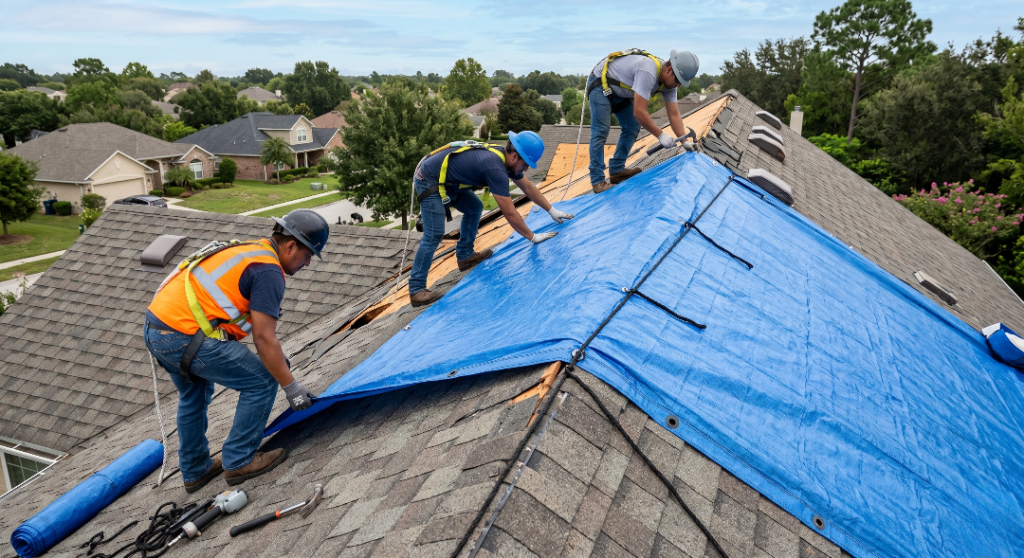
A tarp only works if wind cannot get under it. On a sloped roof, a tarp goes on in these steps:
- Size it past the damage. A heavy, reinforced polyethylene tarp should extend at least 4 feet beyond the damaged area on every side.
- Lap it over the ridge. The top edge wraps onto the other slope, so water from above runs over the tarp.
- Fasten it with wood strips. The edges are rolled around wood furring strips screwed into the roof deck or framing. Sandbags and bricks shift in wind, so we do not use them.
- Seal the fasteners. Screw heads get sealant so they do not become new leaks.
- Photograph the work. You get photos of the damage before it is covered and of the finished tarp.
How Long a Roof Tarp Lasts, and What Comes Next
Plan on weeks, not months. According to FEMA, the U.S. Army Corps of Engineers designs the sheeting it installs under Operation Blue Roof to last 30 days. Sun breaks down plastic, and Santa Ana winds, most common from October through March, can work the edges loose. After a windy day, check the tarp from the ground and call us if an edge is flapping or water is pooling on it.
Downtown Los Angeles gets about 12.4 of its 14.25 inches of yearly rain from November through March, so a tarp put up in December may face several more storms. When the roof has dried, we look over the damaged area, take photos, and put the permanent repair in a free written estimate. If that turns out to be a new roof, our roof replacement cost guide explains what drives the price.
Tarping Records for Your Insurance Claim
The California Department of Insurance advises homeowners to photograph damage before cleanup, make reasonable temporary repairs to prevent further damage, keep receipts, and hold off on permanent repairs until the adjuster has inspected. It also warns about contractors who push expensive temporary repairs. Its tips for storm damage list the other steps.
From us, you get photos of the damage before and after the tarp goes on, a receipt, and a written estimate for the permanent repair to pass along to your insurer. We can also be there when the adjuster visits, if you ask. We don’t file claims, negotiate them, or settle them. Coverage questions belong with your insurer and your policy. See our storm damage roof repair page and our guide to handling a roof insurance claim.
Our Reviews
Posted on GoogleTrustindex verifies that the original source of the review is Google. I live in Alhambra and had a few broken tiles after a windstorm. William and Mike from Overhead Roofing Inc came highly recommended, and now I know why. They handled the repairs quickly and thoroughly, and even checked nearby spots without being asked. Sherry from the office made billing and follow-up a breeze. I’ll be using them again for a full re-roof in the futurePosted on GoogleTrustindex verifies that the original source of the review is Google. Great, thank youPosted on GoogleTrustindex verifies that the original source of the review is Google. Our office in Sierra Madre started having ceiling leaks. Overhead Roofing Inc sent Sean and Mike, who discovered the issue was actually with the parapet wall flashing. They fixed it and gave us solid maintenance recommendations. Tammi kept everything on time and within budget. Their knowledge and clarity made a huge difference.
Need a Roof Tarped or Sealed?
Call (877) 557-7778 at any hour, or send us your address, the roof type, where water is coming in, and a few photos taken from the ground. Our team brings 25+ years of roofing experience, and the estimate for the permanent repair is free.
Get Your Free Estimate
Please fill out the form below, or call: (877) 557-7778
Please fill out the form below, or call:
(877) 557-7778
Need Roof Repair or Replacement? Get a Free Estimate Today!
Don’t wait until a minor issue turns into a significant expense. At Overhead Roofing CA, we make it easy to get expert service fast with no pressure and no hidden fees. From routine roof maintenance to full tear-offs and installations, our team handles every project with precision, honesty, and care.
We specialize in helping LA homeowners and business owners protect their most valuable assets with dependable roofing solutions that last. Our licensed contractors are standing by, ready to inspect your roof, answer your questions, and provide a clear action plan all at no cost to you.
Residential roof repair & replacement
Commercial roofing inspections & upgrades
Emergency leak response & storm damage repair
Financing options available for every budget
Roof Tarping and Temporary Repair Questions
How fast can you get a tarp on my roof?
Call (877) 557-7778 at any hour. Tarp calls get fast response, with same-day visits when crews are available. How soon we arrive depends on the weather, the number of calls after a storm, and whether a branch has to be cleared first. Tell us the roof type and where water is coming in.
How much does emergency roof tarping cost?
It depends on the size of the damaged area, the roof covering and pitch, the height of the building, and whether debris has to be cleared first. Tile, steep, and two-story roofs take longer to cover safely. Ask for the price when you call, and keep the receipt for your insurer.
How long can a tarp stay on a roof?
Treat a tarp as a short-term fix. FEMA notes that the Army Corps of Engineers designs its Operation Blue Roof sheeting to last 30 days. Check the tarp from the ground after every storm or wind event, and book the permanent repair as soon as the roof is dry.
Is it safe to tarp my own roof?
We advise against it, especially right after a storm. Wet shingles and tile are slippery, tile breaks underfoot, and wind can catch a loose tarp hard enough to pull someone off balance. Inside, move belongings away from the drip and photograph the damage while you wait.
Will my insurance pay for emergency roof tarping?
That is a question for your insurer and your policy, so read the policy and report the damage early. The California Department of Insurance advises making reasonable temporary repairs and keeping the receipts. We give you photos, a receipt for the tarping, and a written estimate for the permanent repair.
Serving All of Southern California
Choose your county to see the cities and roofing services near you.