
Overhead Roofing » Roof & Deck Waterproofing
Roof and Deck Waterproofing in Los Angeles
Waterproofing for decks, balconies, roof decks, and parapet walls on Los Angeles County homes and apartment buildings, by a licensed C-39 roofing contractor. Estimates are free.
- Licensed, bonded & insured
- CSLB #1119699 (C-39)
- BBB Accredited, A rating
Roof Waterproofing Services for Decks, Balconies, and Parapets
Roof waterproofing in Los Angeles covers the flat surfaces people walk on and the joints where water gets around a roof: decks and balconies over living space, roof decks, parapet walls, and the transitions at doors and stucco walls. Each one needs a continuous membrane under a surface that can take foot traffic, built so water drains off before it reaches the wood framing or the room below.
The C-39 Roofing classification on our license (CSLB #1119699, active) covers contractors who install products that seal, waterproof, and weatherproof structures. Our team brings 25+ years of roofing experience. We waterproof decks, balconies, and parapets throughout Los Angeles County, as well as in Orange and Ventura counties.
A roof that nobody walks on and only needs its surface renewed is a job for our silicone roof coating service instead.
CSLB #1119699 (C-39)
Every 6 years, 3+ units
November to March
Accredited, A rating

Decks and Balconies Over Living Space
A deck or balcony over a bedroom, a garage, or a living room is a roof that people walk on. It has to keep water out of the room below and away from the wood joists that hold it up, and it has to survive furniture, planters, and daily foot traffic. Deck waterproofing over living space has four parts:
- A sloped base. Plywood or concrete sloped toward a drain, a scupper, or the outer edge, so water drains away from the house.
- A continuous membrane. A sheet or liquid-applied waterproofing layer that runs up every wall and under the door threshold.
- Flashing at every edge. Metal at the outer edge and at drains, and counterflashing or stucco details where the deck meets a wall.
- A walking surface. A deck coating system, tile, or pavers that protect the membrane from wear.
For new balconies and elevated walkways, California’s building code requires the plans to detail an impervious moisture barrier system and the inspections that go with it, and it calls for ventilation in enclosed framing under the walking surface so any moisture that gets in can dry out.
Hillside homes in the Hollywood Hills and other canyon neighborhoods often stack decks over garages and living space, so the deck, the roof edge above it, and the drainage below are planned as one job.

Sheet Membranes, Liquid Membranes, and Walkable Deck Coatings
The right system depends on the base, the finish surface, and how the deck is used:
Self-adhered sheet membranes
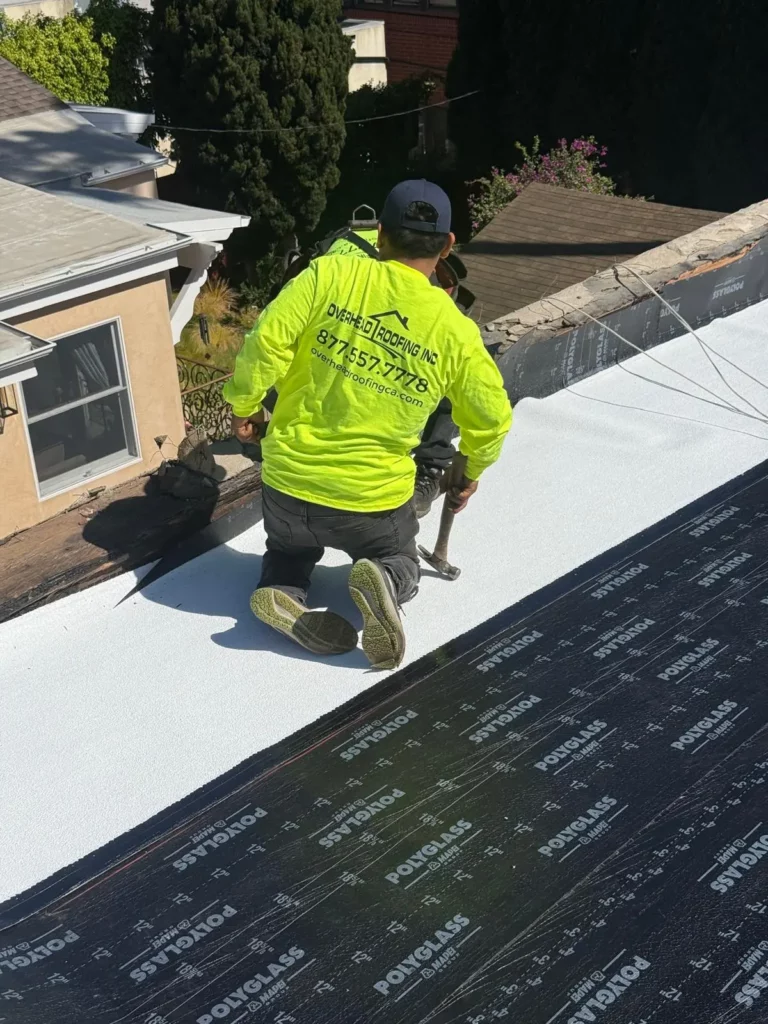
Self-adhered membranes are rubberized asphalt or modified bitumen sheets with a sticky back, rolled onto a primed base and lapped at the seams, like the black membrane in the photo on this page. They go on without a torch, which matters next to wood siding and trim. Most are covered by tile, pavers, or a protection layer, because they are not made to be walked on directly.
Liquid-applied membranes
A liquid membrane is rolled, brushed, or sprayed on and cures into a continuous rubbery layer with no laps. It suits decks with many corners, posts, and drains, where a sheet would need a lot of cut pieces. Its finished thickness depends on the coverage rate, so it goes on in measured coats and is checked as the work goes.
Walkable deck coating systems
A walking deck system combines a waterproof base coat with a textured, wear-resistant top coat, and it is the surface you walk on. Many of these systems are evaluated by ICC Evaluation Service under its acceptance criteria for walking decks (AC39). Ask for the product’s evaluation report. It lists the approved bases, slope limits, and fire classification, which matters if the home is in a fire hazard zone.
Tile or pavers over a membrane
Tile can be set in mortar over a waterproof membrane, with movement joints at the edges. Pavers on adjustable pedestals sit above the membrane and let water run underneath to the drains, and they lift out if the membrane ever needs work. Either way, the membrane is tested before the finish goes on, because it is hard to reach afterward.
Flood testing before the finish
Where a deck can hold water, a flood test checks the membrane before it is covered. The drains are plugged and a shallow depth of water stands on the deck for a set time while the ceiling below is watched. ASTM D5957, the industry guide for these tests, calls for waiting at least 24 hours after the membrane goes on and keeping the water no deeper than 4 inches.
Call our 24/7 line. We offer fast response, with same-day visits when crews are available.
Parapet Waterproofing and Wall-to-Deck Transitions
Many deck and low-slope roof leaks start at the edges rather than in the middle of the membrane. These are the details we waterproof at walls and openings:
- Parapet tops. The top of a parapet wall is waterproofed before the coping goes on, with the membrane wrapped over the wall and the coping sloped toward the roof. Without it, water gets in at the coping joints and runs down inside the wall.
- Inside faces. The deck or roof membrane turns up the inside face of the parapet and finishes under counterflashing or a stucco stop, high enough that standing water cannot reach its top edge.
- Scuppers. A scupper through a parapet gets a sleeve tied into the membrane, so water leaving the deck does not run into the wall around the opening.
- Door thresholds. The membrane turns up under the door with a sill pan, and the deck surface sits low enough below the threshold that wind-driven rain stays outside.
- Stucco walls. Where a deck meets a stucco wall, the membrane runs up behind the weep screed or under counterflashing, so water that gets behind the stucco drains out over the membrane.
For leaks at a chimney, a skylight, or roof-to-wall flashing on a sloped roof, see our roof flashing repair page. Parapet leaks on larger commercial buildings are covered in our guide to parapet and coping leak points.
Balcony Waterproofing and California's Inspection Laws
California requires apartment building owners and condominium associations to have wood-framed balconies, decks, stairways, and walkways more than 6 feet above the ground inspected on a schedule. The inspection includes the flashing, membranes, coatings, and sealants that protect the framing.
- Apartment buildings with three or more units (Health and Safety Code 17973, from SB 721): the first inspection was due by January 1, 2026, and then every six years.
- Condominium associations (Civil Code 5551, from SB 326): the first inspection was due by January 1, 2025, and then every nine years.
A C-39 roofing contractor cannot perform these inspections. Where an inspector’s report calls for new balcony waterproofing, flashing, or a new walking surface, we can give the owner a written estimate for that scope. Repairs to joists, beams, or supports follow the inspector’s or engineer’s direction.
Signs a Deck Membrane Is Failing, and How to Keep It Working
Water from a failing deck membrane usually shows up somewhere else first. Watch for:
- Stains, bubbling paint, or drips on the ceiling below the deck
- Rust streaks, white mineral deposits, or cracked stucco under the deck edge
- Soft spots or bounce in the deck surface
- Cracked tile or grout, or a walkable coating worn through to the base
- Water still standing on the deck a day after rain
- Peeling paint or rot at the fascia and beam ends
If water is coming through a ceiling now, start with our roof leak repair page. Otherwise, plan the waterproofing for the dry months. About 87% of the normal yearly rain in downtown Los Angeles falls from November through March, and a membrane needs a clean, dry base, dry weather to cure, and time for a flood test before tile or pavers go on.
Day to day, keep drains and scuppers clear, set planters on feet so water can pass under them, and don’t drill into the deck for railings, umbrellas, or lights unless each hole is sealed into the membrane. A walkable coating also needs its top coat renewed when wear shows, on the schedule its maker gives.
Our Reviews
Posted on GoogleTrustindex verifies that the original source of the review is Google. I live in Alhambra and had a few broken tiles after a windstorm. William and Mike from Overhead Roofing Inc came highly recommended, and now I know why. They handled the repairs quickly and thoroughly, and even checked nearby spots without being asked. Sherry from the office made billing and follow-up a breeze. I’ll be using them again for a full re-roof in the futurePosted on GoogleTrustindex verifies that the original source of the review is Google. Great, thank youPosted on GoogleTrustindex verifies that the original source of the review is Google. Our office in Sierra Madre started having ceiling leaks. Overhead Roofing Inc sent Sean and Mike, who discovered the issue was actually with the parapet wall flashing. They fixed it and gave us solid maintenance recommendations. Tammi kept everything on time and within budget. Their knowledge and clarity made a huge difference.
Get an Estimate for Your Deck or Balcony
Send us the address, photos of the deck or balcony and the ceiling or wall below it, what the walking surface is, and when the leak shows up. Call (877) 557-7778 or use the form. Estimates are free, and we are licensed under CSLB #1119699 (C-39).
Get Your Free Estimate
Please fill out the form below, or call: (877) 557-7778
Please fill out the form below, or call:
(877) 557-7778
Need Roof Repair or Replacement? Get a Free Estimate Today!
Don’t wait until a minor issue turns into a significant expense. At Overhead Roofing CA, we make it easy to get expert service fast with no pressure and no hidden fees. From routine roof maintenance to full tear-offs and installations, our team handles every project with precision, honesty, and care.
We specialize in helping LA homeowners and business owners protect their most valuable assets with dependable roofing solutions that last. Our licensed contractors are standing by, ready to inspect your roof, answer your questions, and provide a clear action plan all at no cost to you.
Residential roof repair & replacement
Commercial roofing inspections & upgrades
Emergency leak response & storm damage repair
Financing options available for every budget
Deck and Balcony Waterproofing Questions
What is the difference between roof waterproofing and a roof coating?
A roof coating goes over an existing low-slope roof that nobody walks on and renews its surface. Waterproofing builds a full membrane system, usually on a deck, balcony, or roof deck that people use, with flashing at the walls, doors, and drains and a finish that takes foot traffic. A coating maintains a roof; waterproofing is part of how a deck is built.
Can a leaking balcony be fixed without removing the tile?
Sometimes, when the leak is at one edge, a drain, or the door threshold and the membrane under the tile is still sound. A clear sealer on the tile surface does not fix a failed membrane, though, because the water is getting past the layer underneath. If the membrane has failed across the deck, the tile and mortar come off, the base is repaired, and a new membrane and finish go down.
Do you do SB 721 balcony inspections?
No. The law limits that inspection to licensed architects and engineers, qualifying A, B, or C-5 contractors, and qualified building inspectors, and our license is C-39 Roofing. We work from the inspector’s report when it calls for new waterproofing, flashing, or walking surfaces, and we can give the owner a written estimate for that part of the work.
Do you offer roof waterproofing services in the Hollywood Hills?
Yes. We provide roof waterproofing across Los Angeles County, including the Hollywood Hills and other hillside neighborhoods, and we also serve Orange and Ventura counties. On a hillside home, tell us what sits under the deck, such as a garage or a bedroom, and send photos of the ceiling or wall below any leak.
Do you waterproof parapet walls?
Yes, on homes, apartment buildings, and small commercial buildings. Parapet waterproofing covers the top of the wall under the coping, the inside face where the roof or deck membrane turns up, and every scupper through the wall. On larger commercial roofs, parapet work is usually part of a repair or a reroof, and our commercial roofing page covers it.
Serving All of Southern California
Choose your county to see the cities and roofing services near you.