
Overhead Roofing » Roof Flashing Repair
Roof Flashing Repair in Los Angeles
We repair and replace the flashing at walls, chimneys, valleys, skylights, and vents on homes and commercial buildings across Los Angeles County. Estimates are free.
- Licensed, bonded & insured
- CSLB #1119699 (C-39)
- BBB Accredited, A rating
Flashing Repair at Walls, Chimneys, and Vents
Roof flashing repair fixes the metal and rubber pieces that seal the joints in a roof: where the roof meets a wall or chimney, where two slopes meet in a valley, and where pipes and vents come through. Many leaks start at these joints, because the shingles, tile, or membrane stop there and the flashing has to carry the water past the gap. We repair and replace flashing on homes and commercial buildings across Los Angeles County, with free estimates.
For an active leak, call (877) 557-7778 at any hour, or see our page on roof leak repair.
Required over 30 in. wide
0.019 in. min. (No. 26 galv.)
Damaged flashing replaced
CSLB #1119699 (C-39)
Step, Counter, and Headwall Flashing at Stucco Walls
Many Los Angeles homes have stucco walls that meet a roof, such as a second story above a garage or porch roof. Three kinds of flashing seal those joints:
- Step flashing runs up the side of the wall in L-shaped pieces, one under each course of shingles. The California Residential Code calls for this sidewall flashing to be at least 4 inches high and 4 inches wide.
- Counterflashing covers the top edge of the step flashing so water running down the wall cannot get behind it. On stucco, the building paper behind the stucco laps over the flashing.
- Headwall flashing seals the top of a roof slope that runs straight into a wall, such as the wall above a porch roof.
Where the lower edge of a sloped roof ends against a wall, the code also requires kickout flashing to turn water away from the wall and into the gutter. Without it, water runs down the stucco and can rot the framing at that corner.
Wall flashing fails when step flashing rusts through, when pieces were face-nailed or left out, or when sealant stood in for counterflashing. Replacing it means lifting the shingles along the wall and cutting back a narrow strip of stucco so the new metal can tuck behind the paper, then patching the stucco.
Chimney Flashing Repair and Chimney Crickets
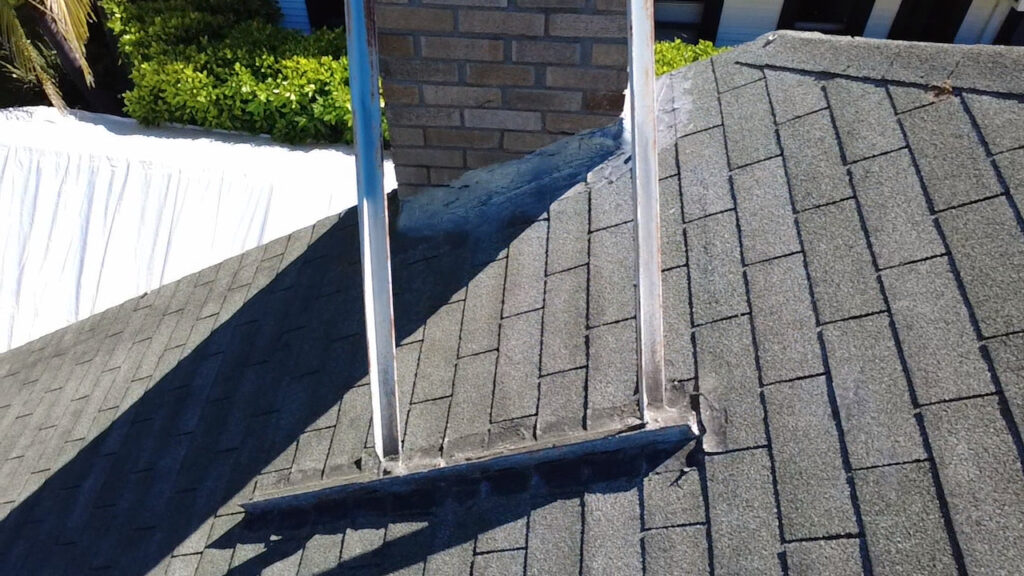
A chimney uses every type of flashing at once: step flashing up the sides, an apron across the downhill face, and a cricket or back pan on the uphill side. All of it is covered by counterflashing set into a mortar joint or into a groove cut into the brick (a reglet). Chimney flashing repair usually involves one of these problems:
- Counterflashing that has pulled out of a cracked mortar joint or a dried-out reglet
- Step flashing that has rusted or torn along the sides
- No cricket behind a wide chimney, so water and leaves pile up against the back
- Roof cement smeared over the joints in place of real flashing
The California Residential Code requires a cricket, also called a saddle, on the uphill side of any chimney more than 30 inches wide. If a wide chimney has none, chimney flashing replacement is the time to add it, since the back of the chimney is already open.
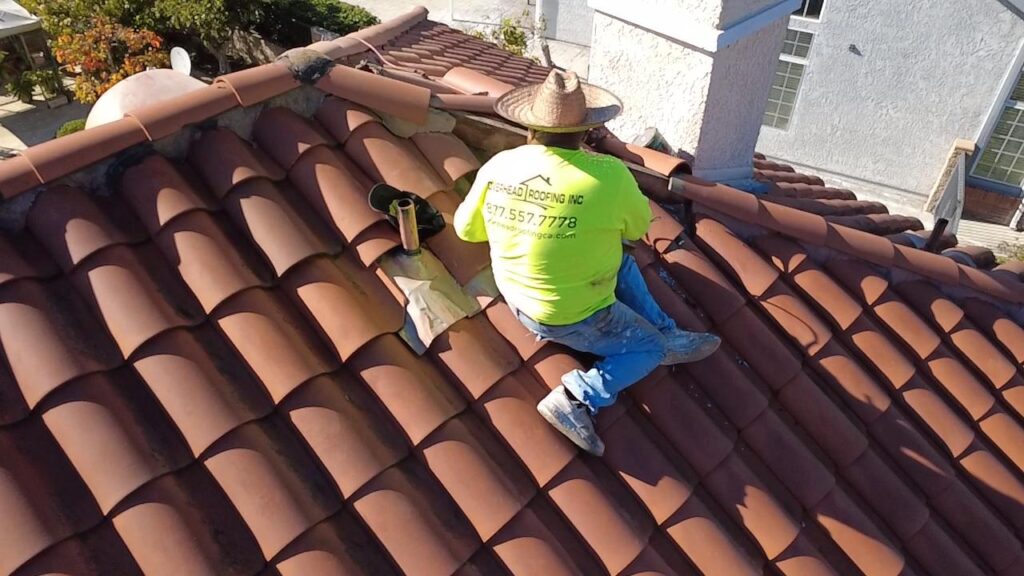
On a clay tile roof in Walnut, our work combined clay tile repair with new chimney flashing. On tile, the surrounding tiles come off and go back on, and the new flashing ties into the underlayment. Cracked bricks or crumbling mortar are masonry problems, and we point them out, because counterflashing set into failing mortar pulls loose again.
Valley Flashing, Pipe Boots, and Vent Flashing
Valley flashing
A valley carries the water from two roof slopes. On a shingle roof with an open valley, a metal lining at least 24 inches wide runs down the center. Valleys leak when the metal rusts, when nails sit too close to the center, or when leaves build up and push water sideways under the roofing. The stain often shows up some distance away, because the water travels along the decking before it drips.
Pipe boots and vent flashing
Plumbing vents pass through the roof inside a pipe boot, a flat base with a rubber collar that seals around the pipe. The rubber cracks in the sun, and water runs down the pipe into the attic. A new boot is a small repair, but the roofing around it still has to be lifted so the base sits under the roofing above it and over the roofing below.
Skylights and drip edge
Skylights are flashed much like a small chimney; see our page on skylight repair. The metal strip along the roof edge is drip edge, covered on our drip edge replacement page.
Call our 24/7 line. We offer fast response, with same-day visits when crews are available.
Flashing on Tile Roofs and Metal Roofs
Tile roofs
On a clay or concrete tile roof, the tile sheds most of the water, but the underlayment beneath it is the waterproof layer. The flashing has to lap into the underlayment, not just sit under the tile. In tile valleys, the code requires the metal to extend at least 11 inches each way from the center, with a raised rib that keeps water from crossing over. Many tile leaks come from flashing that was never lapped in, or from worn underlayment under flashing that still looks fine, so the work often overlaps with tile roof repair.
Metal roofs
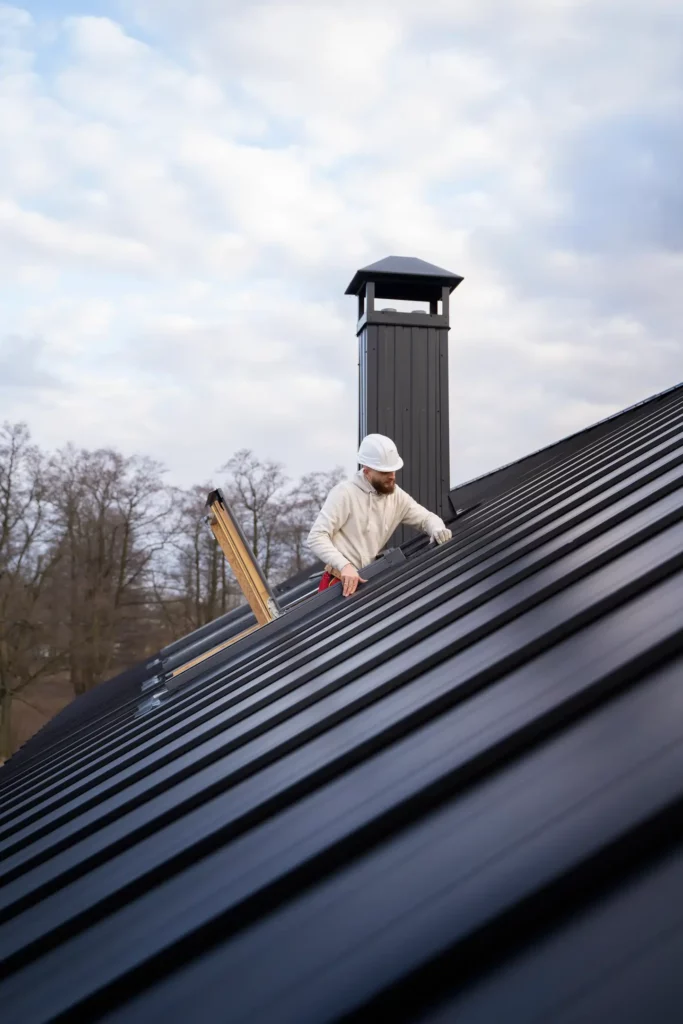
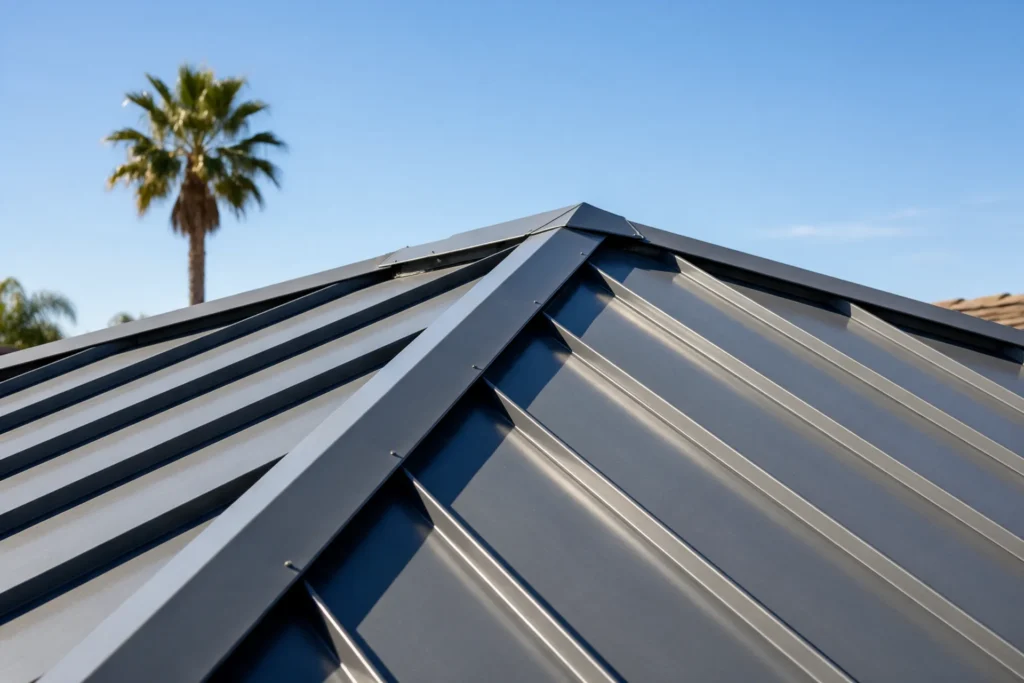
Metal roof flashing repair covers the trim at ridges, walls, eaves, and pipes. The usual problems are loose or backed-out fasteners, dried sealant at laps, and rust where cut edges were left bare or where two different metals touch. New trim has to match the panel profile and be made of a compatible metal.
Commercial Flashing Repair: Parapets, Coping, and Curbs
Apartment, office, retail, and industrial buildings in Los Angeles often have low-slope roofs with their own flashing points. For property and facility managers, these are the places to have checked:
- Parapet walls. The membrane turns up the inside of the parapet and is held at the top by a termination bar or counterflashing. When that edge pulls loose, water gets behind the membrane.
- Coping. Open joints in the cap on top of the parapet let water into the wall. The California Building Code requires the top of a parapet to drain.
- Curbs. HVAC units, exhaust fans, hatches, and skylights sit on curbs flashed on all four sides, and service traffic often damages that flashing.
- Wall terminations and penetrations. These are the joints where the roof meets a taller wall and where pipes, conduit, and supports pass through. Pitch pans need refilling as the filler shrinks.
Commercial flashing repair has to match the membrane, since torch-down and other modified bitumen, TPO, and coated roofs each take different materials. Our article on parapet and coping leaks on LA commercial buildings goes into more detail.
Flashing Repair or Full Flashing Replacement
A repair fixes the piece that failed: a cracked pipe boot, a loose run of counterflashing, or a short section of step flashing. A roof flashing replacement removes all the flashing at a wall, chimney, or valley and installs new metal. Replacement is the better choice when the metal has rusted through in several places or when the flashing was built wrong (face-nailed, caulked instead of lapped, or missing a cricket or kickout). It also makes sense when the joint has been patched before and still leaks.
Why flashing is often replaced during a reroof
Step flashing is woven into the shingles, and tile flashing sits under the tile, so old flashing is hard to reuse once the roofing comes off. The California Residential Code also requires existing flashings, edgings, and vents to be replaced during a reroof where they are rusted, damaged, or deteriorated. If your roof is near the end of its life, replacing the flashing along with the roof can cost less than flashing the same joints twice.
What affects the price of flashing work
The main factors are the roof covering (tile has to be lifted and reset), the roof’s height and pitch, and the chimney’s size and whether it needs a cricket. How much stucco has to be cut and patched, the metal used, and any rotted decking under the old flashing also count. For reroof pricing, see our guide to roof replacement costs in Southern California.
Our Reviews
Posted on GoogleTrustindex verifies that the original source of the review is Google. I live in Alhambra and had a few broken tiles after a windstorm. William and Mike from Overhead Roofing Inc came highly recommended, and now I know why. They handled the repairs quickly and thoroughly, and even checked nearby spots without being asked. Sherry from the office made billing and follow-up a breeze. I’ll be using them again for a full re-roof in the futurePosted on GoogleTrustindex verifies that the original source of the review is Google. Great, thank youPosted on GoogleTrustindex verifies that the original source of the review is Google. Our office in Sierra Madre started having ceiling leaks. Overhead Roofing Inc sent Sean and Mike, who discovered the issue was actually with the parapet wall flashing. They fixed it and gave us solid maintenance recommendations. Tammi kept everything on time and within budget. Their knowledge and clarity made a huge difference.
Get a Roof Flashing Repair Estimate
Tell us where the leak shows up inside and what is on the roof above it: a wall, a chimney, a vent, or a valley. Call (877) 557-7778 or use the form below. Overhead Roofing is licensed, bonded, and insured (CSLB #1119699, C-39), and estimates are free.
Get Your Free Estimate
Please fill out the form below, or call: (877) 557-7778
Please fill out the form below, or call:
(877) 557-7778
Need Roof Repair or Replacement? Get a Free Estimate Today!
Don’t wait until a minor issue turns into a significant expense. At Overhead Roofing CA, we make it easy to get expert service fast with no pressure and no hidden fees. From routine roof maintenance to full tear-offs and installations, our team handles every project with precision, honesty, and care.
We specialize in helping LA homeowners and business owners protect their most valuable assets with dependable roofing solutions that last. Our licensed contractors are standing by, ready to inspect your roof, answer your questions, and provide a clear action plan all at no cost to you.
Residential roof repair & replacement
Commercial roofing inspections & upgrades
Emergency leak response & storm damage repair
Financing options available for every budget
Roof Flashing Repair Questions
How do I know if my roof flashing needs repair?
Inside, look for stains near a chimney, a skylight, or the place where a roof meets a wall. Outside, look for rusted or bent metal, counterflashing pulled away from brick or stucco, cracked rubber on pipe boots, and thick roof cement over joints, which usually marks an earlier leak. A leak that appears only in wind-driven rain also points toward the flashing.
Can leaking flashing be sealed with caulk or roof cement?
Sealant can stop a drip for a while and is a reasonable stopgap before a storm. It does not replace flashing, because it dries, cracks, and pulls away in the sun, and water that gets behind it has no way out. A lasting repair laps the metal so water runs over each joint by gravity, with sealant only as a backup.
What metal is roof flashing made of?
Flashing is usually galvanized steel or aluminum, with copper on some older and higher-end homes. Pipe flashing on tile roofs is often lead or another soft metal shaped over the tile. The California Residential Code requires metal flashing to be corrosion resistant and at least 0.019 inch thick (No. 26 galvanized sheet). Repairs should use a metal compatible with what is already on the roof.
Do you handle commercial flashing repair?
Yes. On commercial and apartment buildings, we repair flashing at parapet walls, coping, equipment curbs, wall terminations, scuppers, and pipe penetrations on low-slope roofs, including torch-down, modified bitumen, TPO, and coated roofs. The repair is matched to the existing membrane, and the property manager gets photos and a written estimate before work starts.
Do you offer roof flashing repair and installation, or only repairs?
Both. Much of what people call flashing repair is really new flashing: new step flashing along a wall, a new chimney flashing set with a cricket, a new valley lining, or new pipe boots. We also install new flashing as part of a reroof or roof replacement, and we can add kickout flashing where a roof edge meets a wall without one.
Serving All of Southern California
Choose your county to see the cities and roofing services near you.