
Overhead Roofing » Flat Roof Replacement
Flat Roof Replacement in Los Angeles
Tear-off and recover flat roof replacement for homes, garages, and apartment buildings by a licensed C-39 roofing contractor across Los Angeles County. Estimates are free.
- Licensed, bonded & insured
- CSLB #1119699 (C-39)
- BBB Accredited, A rating
When to Replace a Flat Roof Instead of Patching It
Flat roof replacement takes off a worn low-slope roof, or covers it where the code allows, and puts a new roof system on an existing home, garage, or apartment building. The first decision is whether the old roof comes off down to the deck or a new roof goes over it, and test cuts usually settle that question.
Replacement is the answer when a flat roof is wet underneath, leaks in new places each rainy season, or is worn across most of its surface. If the problem is one leak, start with flat roof repair. If you are adding a roof to a new structure, see flat roof installation. Our team brings 25+ years of roofing experience. Estimates are free and come in writing.
Overhead Roofing is a Polyglass Premio Select Contractor (#9272). Polyglass makes modified bitumen membranes, including torch-down cap sheets, and roof coatings used on flat roofs.
Not over 2+ existing roofs
Over half the roof replaced
LADBS express reroof permit
CSLB #1119699 (C-39)

Tear-Off or Recover: Two Ways to Replace a Flat Roof
A flat roof can be replaced in two ways, and a coating is a third option while the roof is still sound:
| Option | What happens | When it fits | Trade-offs |
|---|---|---|---|
| Tear-off | Everything is stripped to the deck, bad decking is swapped out, and the new system is built on top | Wet insulation, a soft deck, two or more existing roofs, or drainage that needs rebuilding | More labor and disposal, but every problem under the roof is exposed and fixed |
| Recover | A new roof goes over the existing one, often with a cover board between them | One existing roof that is dry, firmly attached, and sound | Skips the tear-off, but the roof gets heavier and the old layers stay hidden underneath |
| Coating | A liquid coating renews the existing surface | A sound roof with dry insulation and no deck damage | Renews the surface but does not fix wet layers or drainage |
Recover limits: 2025 California Residential Code R908.4 and California Building Code 1512.3.
The code rules out a recover in three cases: the building already has two or more roof coverings, the old roof is water-soaked or too deteriorated to work as a base, or the old covering is tile or slate. To check, we cut small test openings that show how many layers there are and whether the insulation underneath is wet. Coatings are covered on our roof coating page.
What a Flat Roof Tear-Off Uncovers
A flat roof tear-off removes every layer down to the deck: cap sheets, old plies, gravel, and wet insulation. Gravel from an old built-up roof cannot be reused. With the deck exposed, soft plywood and rotted boards are cut out and replaced, and a sagging deck that points to framing problems is handled as structural roof repair before the new roof goes on.
Sound decking stays. On a low-slope reroof in Pomona, the old roofing came off, the existing decking stayed, and the new base sheet went down over it ahead of the torch-down cap sheet. Our flat roof project in Bell, on an auto service building, finished with torch-down and a reflective cap sheet.
Each day’s tear-off is sized to what the crew can dry in before leaving. That matters most in the November-to-March rainy season, which is when Los Angeles gets most of its yearly rain.

Fixing Ponding and Drainage While the Roof Is Off
A replacement is the easiest time to fix a roof that holds water. The roofing industry calls drainage positive when the roof drains within 48 hours of rain in drying weather, and a roof that misses that mark needs more slope or better outlets. Common fixes include:
- Tapered insulation or crickets that move water toward drains and scuppers
- Larger or additional scuppers through parapet walls
- A new gutter edge along a sagging roof edge, once the framing is corrected
- New drain bodies and strainers set level with or below the surrounding roof
On commercial and apartment buildings, the California Building Code also protects what is already there: existing overflow drains or scuppers cannot be removed during a reroof unless they are replaced.
Call (877) 557-7778 any time, or use the form below. Office hours are Sunday through Friday, 8 a.m. to 5 p.m.
Flat Roof Replacement on Homes, Garages, and Apartment Buildings
Each building type changes how the work is planned:
Whole-house flat roofs
Many mid-century and modern homes have low-slope roofs with little or no attic, so the living space sits right under the deck. The work is planned in sections that are dried in each day. Where the roof meets wood siding or trim, self-adhered modified bitumen can replace torch-applied sheets near the combustible material.
Flat garage roof replacement
Garage roofs are sometimes old roll roofing or built-up layers over board sheathing, and they are often where sagging rafters and rotted edges show up first. Replacing a garage roof on its own is common, and it is a good time to correct the slope and the edge where water drains off.
Flat sections on sloped-roof houses
Room additions and porches often have a flat section tied into a shingle or tile roof. When the flat section is replaced, the joint is opened, new flashing is run under the sloped roofing, and the shingles or tiles along that joint are reset or replaced.
Apartment buildings
An apartment roof replacement comes with residents below, parking and access to plan, parapets with scuppers, and many plumbing vents. Residents need notice of the work dates and the areas affected. On multifamily buildings, the cool roof rule kicks in once the reroof covers over 2,000 square feet or over 50 percent of the roof, whichever is smaller.
Foam roofs
Some Los Angeles buildings have sprayed polyurethane foam roofs. A foam roof that is still dry and sound can be recoated without a tear-off, which the building code allows. Once the foam is wet, crushed, or worn through, it comes off and the roof is replaced with a membrane system such as torch-down or TPO.
Cool Roof, Fire Rating, and Permit Rules for a Flat Reroof
Cool roof. For a home, California’s cool roof rule applies once a reroof covers over 50 percent of a low-slope roof in climate zones 4 and 6 to 15, an area that takes in most of Los Angeles County, according to the Energy Commission’s compliance manual. Inside its city limits, Los Angeles enforces a separate cool roof ordinance regardless of zone. Either way, the new surface needs a Cool Roof Rating Council (CRRC) rating at or above the required values.
Fire rating. If a home sits in a fire hazard severity zone covered by the California Wildland-Urban Interface Code, a full reroof, or replacing 50 percent or more of the roof within 12 months, has to meet that code’s Class A rule for new roofs.
Permits. LADBS handles City of Los Angeles reroofs through an express permit, skipping plan check, provided the new covering is Class A or B and lighter than 6 pounds per square foot. Outside the city, the local building department issues the reroof permit, and LA County Public Works covers unincorporated communities.
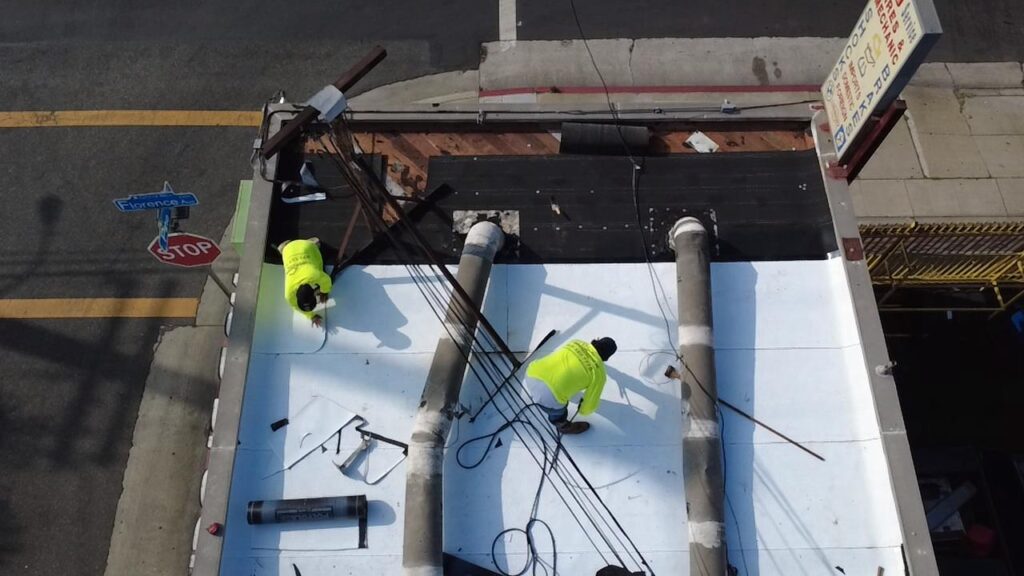
What Sets the Price of a Flat Roof Replacement
Two flat roofs of the same size can be priced far apart. Flat roof replacement cost depends on:
- How many layers come off, and whether they include gravel or foam
- How much decking needs replacing once the deck is exposed
- Tapered insulation, crickets, and drain or scupper work
- Flashing at parapets, stucco walls, and roof-to-wall joints
- Curbs, vents, and rooftop equipment that must be lifted or reflashed
- The roof system and the cool roof product the rules require
- Height, access, and protection for people and property below
If the tear-off finds damaged decking, we show you photos before adding that work. Price ranges reported by public sources are collected in our roof replacement cost guide.
Our Reviews
Posted on GoogleTrustindex verifies that the original source of the review is Google. I live in Alhambra and had a few broken tiles after a windstorm. William and Mike from Overhead Roofing Inc came highly recommended, and now I know why. They handled the repairs quickly and thoroughly, and even checked nearby spots without being asked. Sherry from the office made billing and follow-up a breeze. I’ll be using them again for a full re-roof in the futurePosted on GoogleTrustindex verifies that the original source of the review is Google. Great, thank youPosted on GoogleTrustindex verifies that the original source of the review is Google. Our office in Sierra Madre started having ceiling leaks. Overhead Roofing Inc sent Sean and Mike, who discovered the issue was actually with the parapet wall flashing. They fixed it and gave us solid maintenance recommendations. Tammi kept everything on time and within budget. Their knowledge and clarity made a huge difference.
Get a Flat Roof Replacement Estimate
Tell us the building type, the roof size if you know it, and what you see on the roof: leaks, ponding water, blisters, or soft spots. Photos help. Call (877) 557-7778. We’re licensed, bonded, and insured (CSLB #1119699), and estimates are free.
Get Your Free Estimate
Please fill out the form below, or call: (877) 557-7778
Please fill out the form below, or call:
(877) 557-7778
Need Roof Repair or Replacement? Get a Free Estimate Today!
Don’t wait until a minor issue turns into a significant expense. At Overhead Roofing CA, we make it easy to get expert service fast with no pressure and no hidden fees. From routine roof maintenance to full tear-offs and installations, our team handles every project with precision, honesty, and care.
We specialize in helping LA homeowners and business owners protect their most valuable assets with dependable roofing solutions that last. Our licensed contractors are standing by, ready to inspect your roof, answer your questions, and provide a clear action plan all at no cost to you.
Residential roof repair & replacement
Commercial roofing inspections & upgrades
Emergency leak response & storm damage repair
Financing options available for every budget
Flat Roof Replacement Questions From Owners
Can a new flat roof go over the old one?
Sometimes. A recover is allowed over one existing roof that is dry and sound. It is not allowed where two or more roofs are already in place, where the old roof is water-soaked or badly deteriorated, or over tile or slate. Test cuts tell us the layer count and whether the insulation is wet before we recommend it. If any of those limits apply, the roof comes off down to the deck.
Should I replace my flat roof or keep repairing it?
Keep repairing while the roof is dry underneath and the leaks are in a few known spots. Replace the flat roof when leaks move around each rainy season, test cuts find wet insulation, the surface shows cracks or blisters across most of the roof, or the deck is soft. Our flat roof repair page covers the repair side in more detail.
What can replace a foam roof in Los Angeles?
If the foam is dry and sound, a new coating over it may be all it needs. If it is wet, crushed, or worn through, the foam comes off and the roof can be replaced with torch-down modified bitumen and a cap sheet, or with TPO. Check the drainage either way, because foam is sometimes sprayed thicker in places to create slope, and that slope leaves with the foam.
Do we have to move out during a flat roof replacement?
Usually not. Expect noise during the tear-off, some odor from torch work or adhesives, and crews and ladders around the building. Because many flat roofs sit right over living space, each day’s work is planned so it can be dried in before the crew leaves. Move vehicles away from the work area, and take fragile items off walls and shelves under the roof.
Does replacing a flat garage roof need a permit?
Yes, a garage reroof is still a reroof. In the City of Los Angeles, it can usually go through LADBS’s express permit with no plan check when the new covering is Class A or B and weighs less than 6 pounds per square foot. Other cities and unincorporated county areas have their own permit offices, and we tell you which one applies.
Does a new flat roof have to be white?
On many Los Angeles reroofs, it has to be a CRRC-rated cool roof product, and most of those are white or light-colored. On a house, a reroof of over half the low-slope roof area brings in the state rule across most of the county, and Los Angeles has a city ordinance of its own. Ask to see the rating for the product you are quoted.
Serving All of Southern California
Choose your county to see the cities and roofing services near you.