
Overhead Roofing » Metal Roof Installation
Metal Roof Installation in Los Angeles
Standing seam and metal shingle roofs for Los Angeles County homes, installed by a licensed C-39 roofer with a workmanship warranty. Estimates are free.
- Licensed, bonded & insured
- CSLB #1119699 (C-39)
- BBB Accredited, A rating
Metal Roof Installation for Los Angeles Homes
Metal roof installation in Los Angeles usually means putting the first metal roof on a building: a house switching from asphalt shingles or tile, a new home, or an addition or ADU. Our metal roof installation services cover standing seam panels, metal shingles, and stone-coated steel, along with the tear-off, deck repairs, underlayment, flashing, permit, and final inspection.
Metal roofs are installed under our active C-39 Roofing license, CSLB #1119699. Our team brings 25+ years of roofing experience. Metal roofing in Los Angeles raises three local questions: whether the house is in a fire hazard zone, how close it sits to the ocean, and whether the Title 24 cool roof rules apply. As a metal roofing contractor, we answer all three in a free written estimate.
Already have a metal roof that is rusting or leaking? Replacing an existing metal roof, including corrugated and exposed-fastener roofs on garages and commercial buildings, is covered on our metal roof replacement page. For a leak on a metal roof that is otherwise sound, see metal roof repair.
CSLB #1119699 (C-39)
As low as 1/4 in 12 (CRC)
0.7 to 1.3 lb per sq ft
Accredited, A rating
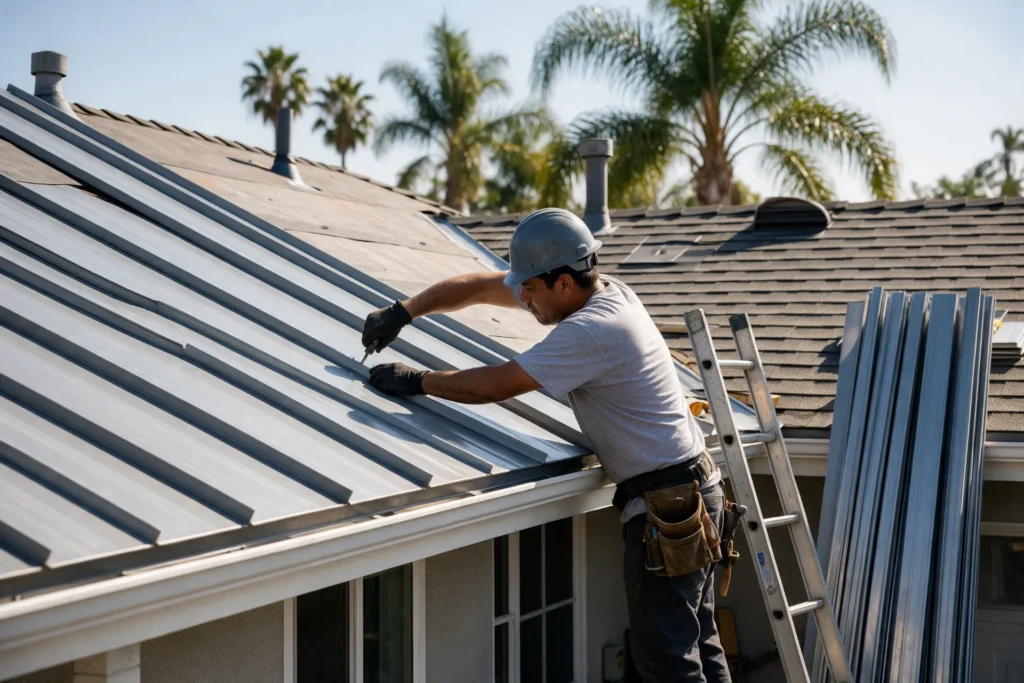
Standing Seam, Metal Shingles, and Ribbed Panels Compared
Most residential metal roofs in Southern California fall into three groups. The main differences are how the metal is fastened and how low a roof pitch it can handle.
| Metal roof type | How it is fastened | Where it fits | Keep in mind |
|---|---|---|---|
| Standing seam panels | Concealed clips under raised seams | Modern and ranch homes, additions, and roofs as low as 1/4 in 12 | Clips let long panels expand and contract with heat |
| Metal shingles and stone-coated steel | Fastened at the top of each piece, under the next course | Homes that want a shingle, shake, or tile look | Pieces on battens leave an airspace, which has extra rules in fire zones |
| Exposed-fastener ribbed or corrugated panels | Screws with sealing washers through the panel face | ADUs, studios, garages, and carports | Needs 3 in 12 of pitch unless the laps are sealed; screws need periodic checks |
Slope figures: California Residential Code R905.10.2 (2025 edition).
Panels come in galvanized steel, aluminum-zinc coated steel, and aluminum, with factory paint finishes. Aluminum is one of the metals the Metal Roofing Alliance prefers for coastal homes. Our guide to standing seam metal roofs explains why that style is so popular.
Switching to Metal From a Shingle or Tile Roof
Most of the metal roofs we install replace another material. These are the points we check before pricing the switch.
Coming from asphalt shingles
A shingle roof usually comes off down to the deck, so we can replace soft or delaminated sheathing and start the metal on a flat, sound surface. California’s code allows some new roofs over one existing layer, but not over two layers or a water-damaged roof. Our reroofing page explains those layer rules, and the estimate states which way we recommend.
Coming from clay or concrete tile
Tile cannot be roofed over, so the tile, battens, and old underlayment all come off. The payoff is weight: the Metal Construction Association puts metal roofing at 0.7 to 1.3 pounds per square foot, compared with 6 to 14 for concrete and clay tile. If you like the tile look, stone-coated steel and metal tile profiles come close to it.
Roof pitch and roof shape
Pitch decides which metal systems you can use. Standing seam can go as low as 1/4 in 12, while lapped exposed-fastener panels need 3 in 12 unless the laps are sealed. Hips, valleys, dormers, and skylights add trim and cutting, so a roof with many planes takes longer than a simple gable.
Color, HOA rules, and neighborhood review
Some homeowner associations and historic districts limit roof color, profile, or material. Check with your HOA before you sign a contract, and send us any written guidelines so the estimate matches them. Color also affects the cool roof rules covered below.
New homes, additions, and ADUs
On new construction, the deck, slope, and ventilation come from the approved plans, and we follow them along with the panel maker’s details. Low-slope additions and patio covers suit standing seam because of its low minimum slope. New homes in some climate zones must also meet the Title 24 cool roof values for steep roofs.
Call (877) 557-7778 any time, or use the form below. Office hours are Sunday through Friday, 8 a.m. to 5 p.m.
Standing Seam Metal Roof Installation, Step by Step
A standing seam metal roof installation on an existing house follows the same order on most jobs:
- Permit. We pull the reroof permit. LADBS puts City of Los Angeles reroofs on its express permit list when the new covering has a Class A or B rating and a weight under 6 pounds per square foot, and metal weighs far less than that; other cities use their own building departments.
- Tear-off and deck repair. The old roofing comes off, and damaged sheathing is replaced.
- Underlayment. An underlayment the panel maker approves covers the deck, with extra protection at valleys and walls.
- Edge metal and flashing. Eave, rake, valley, and wall flashing go on before the panels. At stucco walls, the wall flashing is covered by a counterflashing.
- Clips and panels. Clips are fastened at the manufacturer’s spacing, and each panel locks or is seamed to the next.
- Ridge and hips. Trim goes on over closures, with a vented ridge where the attic vents at the peak.
- Final inspection. Once the inspector signs off, you receive the permit record and our workmanship warranty.
Most of the region’s rain comes between November and March. In those months, each day’s work is planned so any opened section can be closed up before the crew leaves.
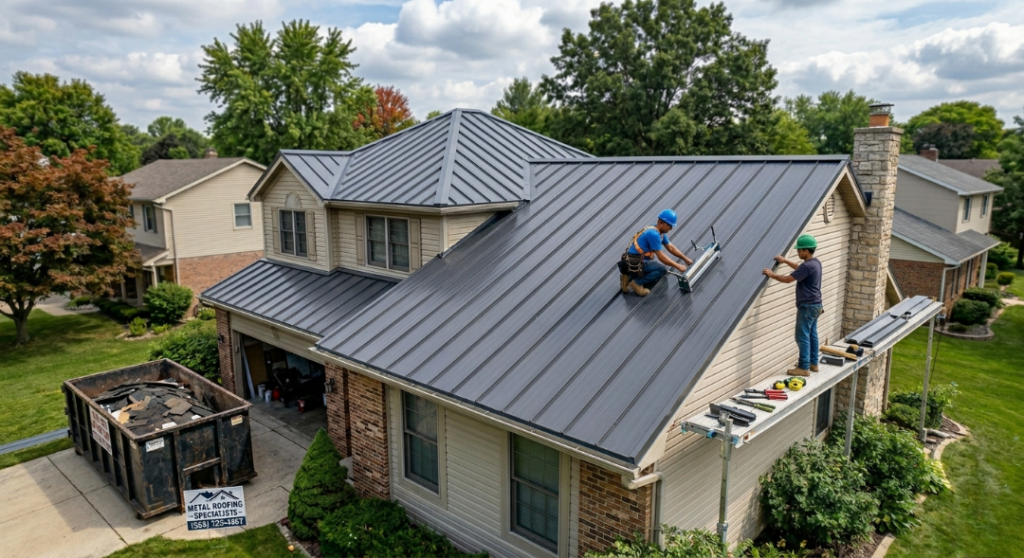
Fire Zones, Wind, Heat, and Coastal Air on a Metal Roof
Fire hazard zones. Homes in the fire hazard severity zones of the state’s Wildland-Urban Interface Code need a Class A roof assembly. Metal over a wood deck is Class A only when the whole assembly, underlayment included, is tested and listed that way, so we confirm the listing for the exact panel and underlayment. Where panels leave an airspace over the deck, as stone-coated steel on battens does, the code adds a cap sheet or a Class A tested underlayment and bird stops at the eaves.
Santa Ana winds. Santa Ana winds are dry, blow mostly between October and March, and gain speed in passes and canyons. Clip spacing, edge trim, and ridge fastening follow the manufacturer’s details, with extra attention at the eaves, rakes, and ridge.
Cool roof rules. If a reroof replaces over half of a house’s roof, Title 24 applies cool roof minimums to steep roofs in climate zone 4 and zones 8 to 15: 0.20 aged solar reflectance and 0.75 thermal emittance, or an SRI of 16. Metal makes up close to half of the products the Cool Roof Rating Council rates, so meeting the rule usually means picking a rated color. Our guide to cool roofing in California covers the exceptions.
Salt air. Salt air speeds up corrosion on metal roofs. Suppliers define a marine environment by distance from salt water, anywhere from about 1,000 feet to a mile, so read the panel and paint warranties for coastal terms. Some metals also corrode when they touch, stainless steel against aluminum or coated steel panels for example, so flashing, gutters, and fasteners are matched to the roof.
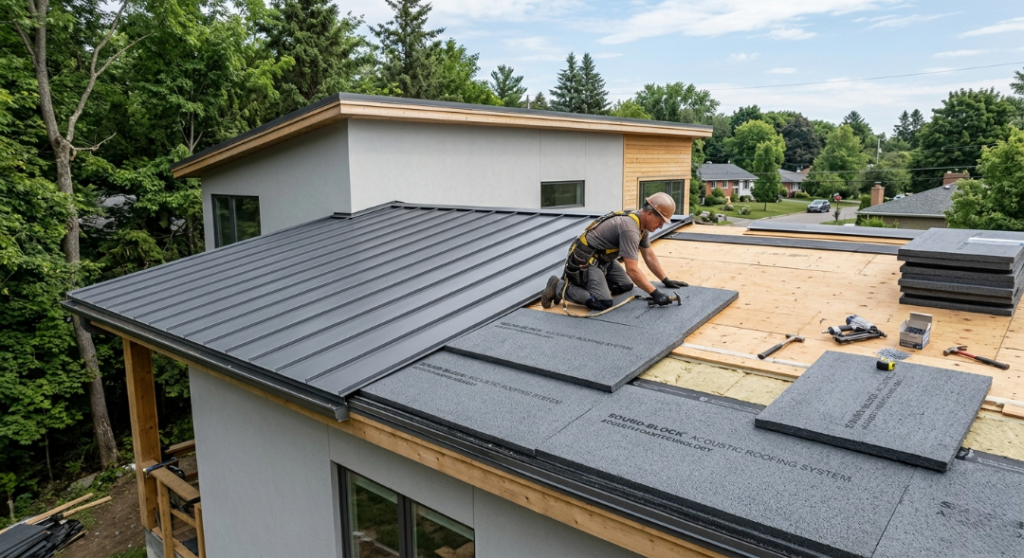
What Sets the Price of a Metal Roof Installation
Metal roofs vary too much from house to house for a price list to be useful. These are the things that move the number:
- The metal system, gauge, and finish you choose
- Roof area, pitch, and the number of hips, valleys, and dormers
- The roofing that comes off first: one layer of shingles, several layers, or tile and battens
- Deck repairs found after the tear-off
- Chimneys, skylights, solar mounts, and walls that need new flashing
- Fire zone, cool roof, and coastal requirements
- Access, roof height, and how far materials have to be carried
Estimates are free and written. For published price ranges and the sources behind them, see our roof replacement cost guide.
Our Reviews
Posted on GoogleTrustindex verifies that the original source of the review is Google. I live in Alhambra and had a few broken tiles after a windstorm. William and Mike from Overhead Roofing Inc came highly recommended, and now I know why. They handled the repairs quickly and thoroughly, and even checked nearby spots without being asked. Sherry from the office made billing and follow-up a breeze. I’ll be using them again for a full re-roof in the futurePosted on GoogleTrustindex verifies that the original source of the review is Google. Great, thank youPosted on GoogleTrustindex verifies that the original source of the review is Google. Our office in Sierra Madre started having ceiling leaks. Overhead Roofing Inc sent Sean and Mike, who discovered the issue was actually with the parapet wall flashing. They fixed it and gave us solid maintenance recommendations. Tammi kept everything on time and within budget. Their knowledge and clarity made a huge difference.
Get a Written Estimate for a New Metal Roof
Send us your address, a few photos of the current roof, and the metal style you have in mind, or call (877) 557-7778. We will measure the roof, check the pitch and decking, and give you a free written estimate. We are licensed under CSLB #1119699 (C-39).
Get Your Free Estimate
Please fill out the form below, or call: (877) 557-7778
Please fill out the form below, or call:
(877) 557-7778
Need Roof Repair or Replacement? Get a Free Estimate Today!
Don’t wait until a minor issue turns into a significant expense. At Overhead Roofing CA, we make it easy to get expert service fast with no pressure and no hidden fees. From routine roof maintenance to full tear-offs and installations, our team handles every project with precision, honesty, and care.
We specialize in helping LA homeowners and business owners protect their most valuable assets with dependable roofing solutions that last. Our licensed contractors are standing by, ready to inspect your roof, answer your questions, and provide a clear action plan all at no cost to you.
Residential roof repair & replacement
Commercial roofing inspections & upgrades
Emergency leak response & storm damage repair
Financing options available for every budget
Metal Roofing Questions From Los Angeles Homeowners
Can a metal roof go over my existing shingles?
Sometimes. California’s code allows a new roof over one existing layer when that layer is sound and the panel maker’s instructions allow it, but not over two or more layers, a water-soaked roof, or tile. We usually recommend a tear-off, because it lets us check and repair the deck before the metal covers it. Our reroofing page explains the layer rules in detail.
Is a metal roof Class A fire rated?
A metal roof can be part of a Class A assembly, but the rating belongs to the tested assembly, not to the metal alone. Over a wood deck, the panels, underlayment, and deck have to match a listed Class A assembly. Inside the fire hazard severity zones that the state wildfire code covers, Class A is required, so we confirm the listing before we order materials.
Do I need a permit for metal roof installation in Los Angeles?
Yes. A metal reroof needs a permit like any other reroof. Inside Los Angeles city limits it usually gets an LADBS express permit, which skips plan check, since metal is far lighter than the 6-pound-per-square-foot limit for Class A or B coverings. Other cities run their own permit counters, and unincorporated areas go through LA County Public Works. We take out the permit and book the inspections.
Will a metal roof meet California's cool roof requirements?
It can. Where the rule applies, a steep residential roof needs a product with a Cool Roof Rating Council label that meets the minimums in the section above, and many metal colors carry CRRC ratings. Your climate zone and how much of the roof is being replaced decide whether the rule applies to your job.
Do you install metal roofing in Glendale and the San Fernando Valley?
Yes. Our metal roofers work throughout Los Angeles County, with Glendale, Pasadena, Burbank, and the San Fernando Valley among the areas, and we take jobs in Orange and Ventura counties as well. Fire zones, distance from the ocean, and the permit office change from city to city, so each estimate is written for the specific address.
Serving All of Southern California
Choose your county to see the cities and roofing services near you.