
Overhead Roofing » Reroofing
Reroofing in Los Angeles: Overlay or Tear-Off
Overlay or tear-off, decided by the layers, the decking, and the code that applies to your roof. Licensed, bonded, and insured. Estimates are free.
- Licensed, bonded & insured
- CSLB #1119699 (C-39)
- BBB Accredited, A rating
Reroofing Options for an Existing Roof
Reroofing means putting a new roof covering on an existing building, either over the roofing already there (an overlay, which the code calls a recover) or after tearing it off down to the deck. Which option your roof qualifies for depends on how many layers it already has, the condition of the decking, and the type of roofing.
We reroof homes and small buildings across Los Angeles County, and we count the layers and check the decking before recommending either option. If you already know the old roof is coming off and want the full process, from permit to final inspection, see our roof replacement page. Overhead Roofing is licensed, bonded, and insured (CSLB #1119699, C-39), and every estimate is free and in writing.
Not over 2 or more layers
No overlay allowed
LADBS express permit
CSLB #1119699 (C-39)
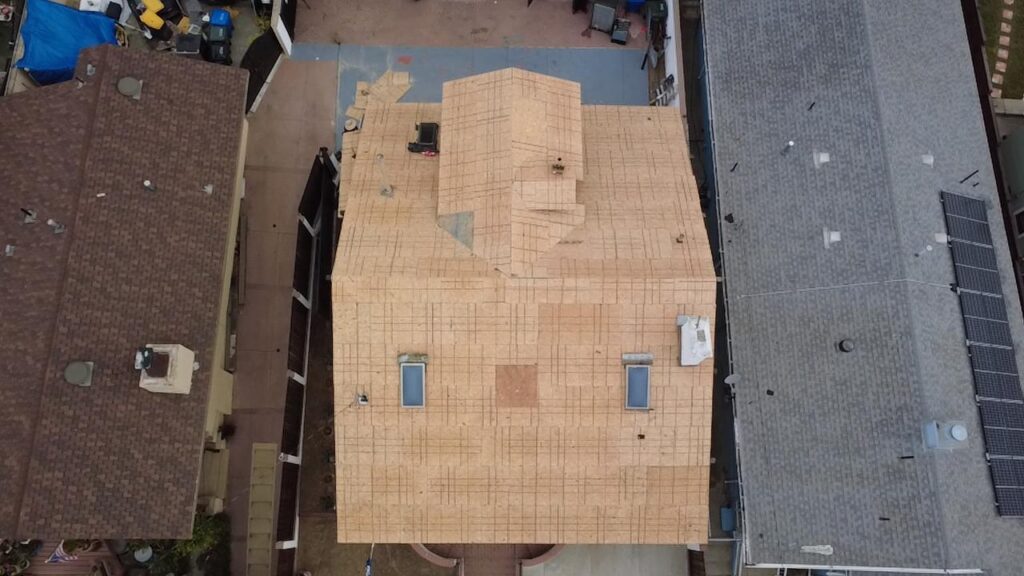
Roof Overlay vs. Tear-Off, Side by Side
Both options end with a new roof surface. The difference is what happens to the old roofing and how much of the roof gets seen:
| Factor | Overlay (recover) | Tear-off |
|---|---|---|
| What happens | New roofing goes over one existing layer | Old roofing comes off down to the roof deck |
| Roof deck | Stays covered, so soft or rotted spots can’t be found or replaced | Fully exposed, and damaged sheathing is replaced |
| Flashing and edge metal | Rusted or damaged pieces must still be replaced | New flashing, drip edge, and underlayment throughout |
| Weight | Adds a layer the framing has to carry | One layer, on a deck that has been checked |
| When it’s allowed | A single dry, sound layer that is not tile or slate | Always; required with two or more layers, a wet roof, or tile |
| The next reroof | Two layers to remove | One layer to remove |
Based on the 2025 California Residential Code, Sections R908.2 through R908.6.
On homes, the usual overlay is asphalt shingles over one existing layer of shingles. A tear-off costs more up front, but it is the only way to see and repair the decking. On a shingle reroof in Whittier, the old roofing came off and the new shingles went down over new plywood decking. In Altadena, a tear-off uncovered water-damaged decking along the roof edge, which was replaced before the new roof went on.
Layer Rules for Roofing Over Existing Shingles
California’s Residential Code allows new roofing over an existing roof only when it is installed to the manufacturer’s instructions, and it rules out an overlay where:
- the existing roof already has two or more layers of roofing of any type;
- the existing roof is water-soaked or so deteriorated that it can’t serve as a base;
- the existing roofing is slate, clay tile, concrete tile, or asbestos-cement tile.
In practice, a house can carry two layers of shingles at most: the original roof plus one overlay, a limit Calabasas’s reroof handout states outright. A roof that has already been overlaid once has to be torn off.
The code’s reroofing section adds conditions for any overlay. The framing must be able to carry the extra weight. Rusted, damaged, or deteriorated flashing, edge metal, and vents can’t be reused, and flashing has to be rebuilt to the manufacturer’s instructions. Going over wood shakes can require covering them first with gypsum board or a similar approved material. Inside the City of Los Angeles, the building code’s own overlay table allows no overlay of any kind on a tile roof and only metal over an existing metal roof.
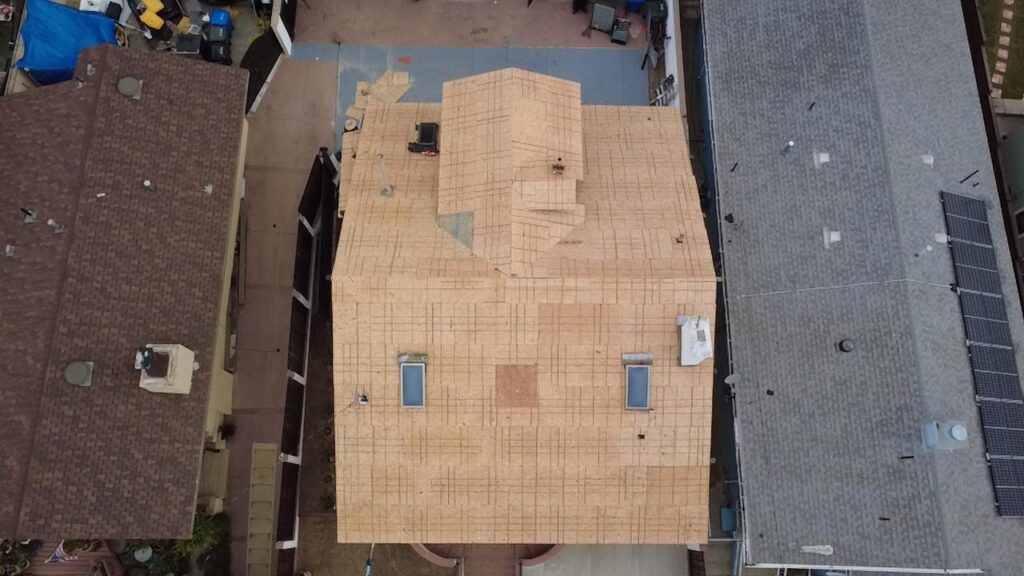
What We Check Before Recommending an Overlay
A shingle roof that qualifies on paper can still be a poor base. Before we price an overlay, we look at:
The layer count
We count layers at the roof edge, at a vent opening, or with a small test cut. Older roofs sometimes hide a second layer of shingles, or old wood shakes, under the roofing you can see from the street. Two or more layers end the discussion, because the code requires a tear-off.
The decking
On the roof, we feel for spots that give underfoot. From the attic, we look for stains, delaminated plywood, and sagging between rafters. Soft or rotted sheathing can only be replaced with the roofing off, so a deck with problems in more than a spot or two points to a tear-off.
Active leaks
A roof that is leaking now has wet underlayment or decking somewhere, and the code does not allow an overlay over a water-soaked roof. Covering it would trap the moisture and hide the entry point. The leak has to be traced and repaired first, which means opening that part of the roof anyway.
The shape of the old shingles
New shingles take the shape of whatever is under them. Curled, cupped, or buckled shingles telegraph through the new layer as ripples, and the new shingles may not lie flat enough for their seal strips to bond. A flat, worn first layer makes a better base than a lumpy one.
Flashing, vents, and drip edge
Step flashing, chimney flashing, pipe boots, and drip edge all have to work with the thickness of a second layer, and any that are rusted or damaged must be replaced. When most of the metal needs replacing anyway, much of what an overlay saves goes back into the job.
Call (877) 557-7778 any time, or use the form below. Office hours are Sunday through Friday, 8 a.m. to 5 p.m.
Reroofing Permits, Inspections, and Code Upgrades
Plan on a permit for either kind of reroof. Inside the City of Los Angeles, a reroof using Class A or B roofing that weighs under 6 pounds per square foot qualifies for an LADBS express permit, with no plan check. Los Angeles County Public Works issues permits in unincorporated areas, and other cities issue their own. Some inspect the roof before the new layer covers it; Calabasas requires a sheathing inspection on every recover and replacement. We pull the permit and schedule inspections.
An overlay is still a reroof under the Energy Code, which covers adding a new surface layer on top of an existing roof. Once more than half the roof is reroofed, cool roof values apply. Steep-slope roofs must meet them in climate zones 4 and 8 through 15, and low-slope roofs in zones 4 and 6 through 15. LADBS also asks for a CRRC-labeled cool roof product on any home reroof over 50 percent of the roof area. Our cool roof guide lists the values and exceptions.
Fire ratings apply the same way. LADBS requires Class A roofing for homes in Very High Fire Hazard Severity Zones, and where the state’s Wildland-Urban Interface Code applies, roofing used in any alteration or repair must be at least Class A. LADBS also tracks reroofing over time: once more than 50 percent of a roof is reroofed within any one-year period, the entire roof must comply with current code.
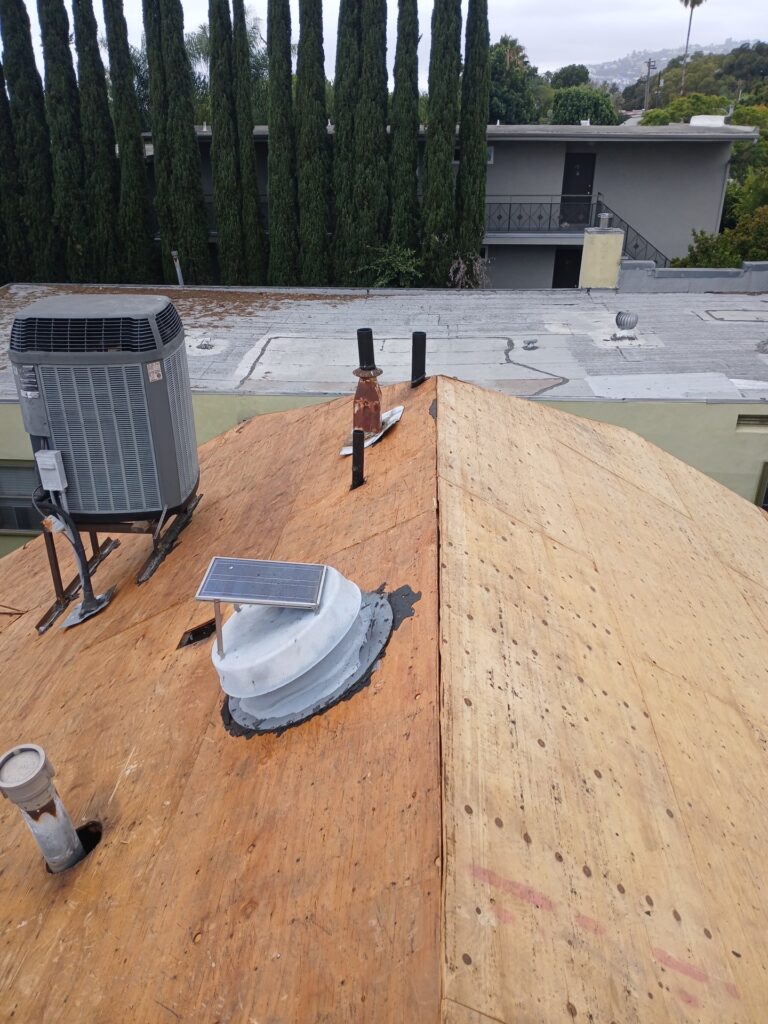
Partial Reroofs, Flat Sections, and Tile Roofs
Not every reroof covers the whole house. These are the common partial and special cases:
- One slope or one wing. A worn rear slope or an older addition can be reroofed on its own, with the new roofing flashed or woven into the old at the joint. In the City of Los Angeles, keep the one-year count in mind.
- Low-slope sections. Flat roofs over garages, porches, and additions are often reroofed separately from the pitched roof around them. In Pomona, we reroofed a low-slope roof in torch-down. Flat roofs have their own recover rules, covered on our flat roof replacement page.
- Tile roofs. An overlay is not an option on tile. The usual tile reroof is a reset: we lift the tiles, lay new underlayment, and re-lay the sound tiles, replacing any that are broken. See tile roof replacement.
Cost depends on roof area and pitch, overlay or tear-off, the number of layers coming off, decking repairs, flashing and edge metal, cool roof and fire-rating requirements, and access. Our roof cost guide explains how reroofs are priced, and your written estimate is free.
Our Reviews
Posted on GoogleTrustindex verifies that the original source of the review is Google. I live in Alhambra and had a few broken tiles after a windstorm. William and Mike from Overhead Roofing Inc came highly recommended, and now I know why. They handled the repairs quickly and thoroughly, and even checked nearby spots without being asked. Sherry from the office made billing and follow-up a breeze. I’ll be using them again for a full re-roof in the futurePosted on GoogleTrustindex verifies that the original source of the review is Google. Great, thank youPosted on GoogleTrustindex verifies that the original source of the review is Google. Our office in Sierra Madre started having ceiling leaks. Overhead Roofing Inc sent Sean and Mike, who discovered the issue was actually with the parapet wall flashing. They fixed it and gave us solid maintenance recommendations. Tammi kept everything on time and within budget. Their knowledge and clarity made a huge difference.
Find Out Whether Your Roof Can Take an Overlay
Tell us the roof type, its approximate age, and how many layers you think it has, and mention any leaks or soft spots. Call (877) 557-7778 or use the form below. Estimates are free, and we work under CSLB license #1119699 (C-39) as a bonded and insured contractor.
Get Your Free Estimate
Please fill out the form below, or call: (877) 557-7778
Please fill out the form below, or call:
(877) 557-7778
Need Roof Repair or Replacement? Get a Free Estimate Today!
Don’t wait until a minor issue turns into a significant expense. At Overhead Roofing CA, we make it easy to get expert service fast with no pressure and no hidden fees. From routine roof maintenance to full tear-offs and installations, our team handles every project with precision, honesty, and care.
We specialize in helping LA homeowners and business owners protect their most valuable assets with dependable roofing solutions that last. Our licensed contractors are standing by, ready to inspect your roof, answer your questions, and provide a clear action plan all at no cost to you.
Residential roof repair & replacement
Commercial roofing inspections & upgrades
Emergency leak response & storm damage repair
Financing options available for every budget
Reroofing and Roof Overlay Questions
What is a reroof?
A reroof is any job that puts a new roof covering on an existing building. It can be an overlay, where new roofing goes over one existing layer, or a tear-off, where the old roofing comes off down to the deck first. Which one your roof qualifies for depends on its layers, decking, and material.
Can you put a new roof over an old roof in California?
Sometimes. The California Residential Code allows new roofing over a roof that has a single existing layer, is dry and sound, and is not slate or tile. The new roofing also has to go on to its manufacturer’s instructions. If the roof already has two layers, is soaked or deteriorated, or is tile, the old roofing has to come off first.
How many layers of shingles are allowed on a roof?
Two at most. The code does not allow an overlay where the roof already has two or more layers, so the original roof plus one overlay is the limit, and a third layer means a full tear-off. If you are not sure how many layers your roof has, we can count them at the edge or at a vent before you decide.
Do I need a permit to reroof in Los Angeles?
Yes. Inside Los Angeles city limits, LADBS issues the permit, and Class A or B roofing lighter than 6 pounds per square foot gets an express permit with no plan check. Elsewhere, your city’s building department issues it, or Los Angeles County Public Works if the home is in an unincorporated area. Either way, we pull the permit as part of the job.
Is a roof overlay cheaper than a tear-off?
Usually, because there is no old roofing to remove and haul away. The gap narrows when flashing, vents, and drip edge need replacing anyway, and an overlay leaves two layers for the next reroof to remove. It also keeps the decking hidden. When a roof qualifies for an overlay, we can price both options.
Is reroofing the same as roof replacement?
They overlap. A tear-off reroof is a roof replacement: the old roof comes off and a new one is built from the deck up. An overlay is a form of reroofing that keeps the old layer in place, so it is not a full replacement. Our roof replacement page walks through the tear-off process from start to finish.
Serving All of Southern California
Choose your county to see the cities and roofing services near you.