
Overhead Roofing » Commercial Roofing
Commercial Roofing in Los Angeles
Repair, recover, and replacement for the low-slope roofs on warehouses, shops, offices, and apartment buildings across Los Angeles County. Estimates are free.
- Licensed, bonded & insured
- CSLB #1119699 (C-39)
- BBB Accredited, A rating
Commercial Roofers for Los Angeles Buildings
Commercial roofing in Los Angeles covers the low-slope roofs on warehouses, shops, restaurants, offices, and apartment buildings, along with the drains, parapets, and rooftop equipment that come with them. Our commercial roofers repair, recover, and replace torch-down modified bitumen, TPO, built-up, and coated roofs, and we plan each job around the tenants and business hours below the roof.
Overhead Roofing holds an active C-39 Roofing license (CSLB #1119699), and our team brings 25+ years of roofing experience. As commercial roofers in Los Angeles County, we give owners and facility managers a free written estimate and photos of what we find. For a leak into a tenant space that cannot wait, our emergency line, (877) 557-7778, is open 24/7.
CSLB #1119699 (C-39)
Over 50% or over 2,000 sq ft
24/7: (877) 557-7778
Accredited, A rating

Flat Roof Systems
Torch-down, TPO, built-up, and coated low-slope roofs, and where each one fits.
Commercial Roof Repair
Leaks at seams, drains, parapets, and rooftop equipment, found and fixed.
Maintenance and Coatings
Scheduled checkups, drain cleaning, and coatings for roofs that are still sound.
Commercial Roofing in Los Angeles by Building Type
A building’s use decides where its roof wears out first and how the work is scheduled. These are the patterns we plan for:
- Warehouses and light industrial buildings. Large roofs with long runs to a few drains, plus skylights and exhaust fans. Industrial roofing in Los Angeles is mostly about drainage and keeping stock and equipment dry.
- Retail centers and strip malls. Parapet walls along the storefronts, often a separate HVAC unit for each tenant, and sign brackets and conduit fastened through the roof.
- Restaurants. Kitchen exhaust fans put grease on the roof, and grease breaks down many roof membranes, so the area around each fan needs protection and regular cleaning.
- Apartment buildings. Low parapets, stucco walls that rise above the roof, many small plumbing vents, and residents living directly below the work.
- Offices and medical buildings. Rooftop HVAC curbs, ductwork, and hatches, plus service technicians walking the roof to reach them.
- Auto service buildings. Low-slope roofs over working bays, with exhaust vents through the roof. Our Bell project, an auto service building, was finished in torch-down modified bitumen with a reflective cap sheet.
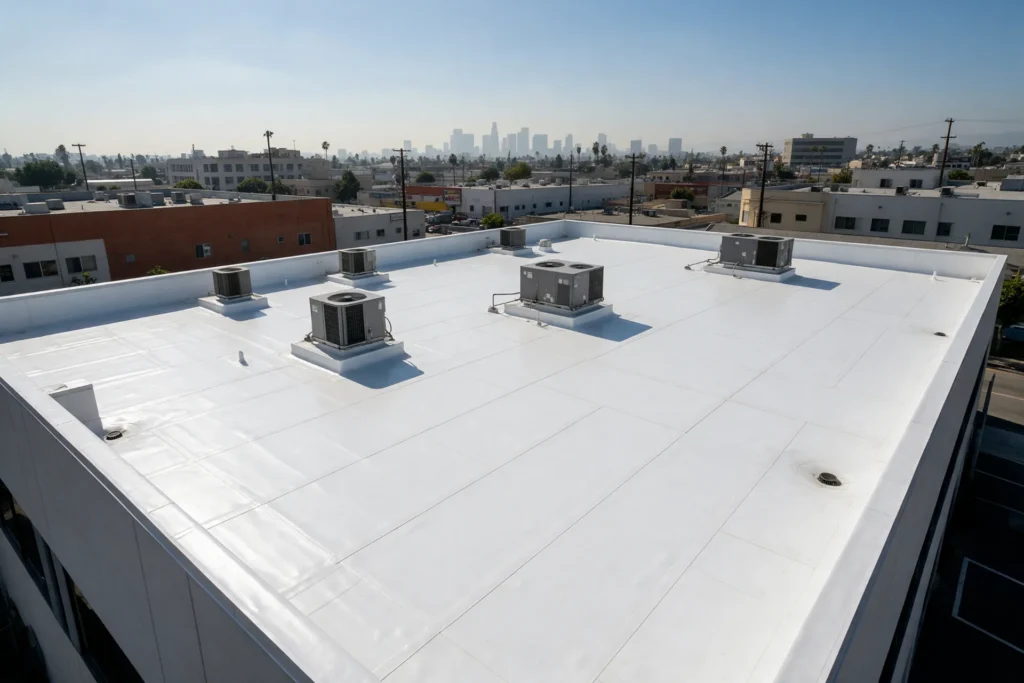
Commercial Roof Systems and Where Each One Fits
Here are the systems we work with on commercial roofs and the buildings each one suits:
| System | Good fit for | Keep in mind |
|---|---|---|
| Modified bitumen (torch-down) with a cap sheet | Shops, auto service buildings, apartment buildings, and roofs with foot traffic | A base sheet plus a mineral cap sheet. Torch work needs a dry roof and care near anything combustible. |
| TPO single-ply | Large, open roofs where a white surface helps keep the building cool | Heat-welded seams. Every curb and penetration needs careful detailing. |
| Built-up roof (BUR) | Older buildings that already have one | Often repairable. Before a recover, check the weight and the number of layers already on the roof. |
| Silicone coating | A sound roof with dry insulation and a solid deck | Goes over the existing roof, so the insulation and deck under it must be dry and sound. |
For a large roof where a bright white surface helps with cooling, TPO is worth pricing, and our TPO roofing page covers it in detail.
On a commercial building in Los Angeles, we applied a silicone coating over the existing roof instead of tearing it off. Our roof coating page explains which roofs qualify.
Call our 24/7 line. We offer fast response, with same-day visits when crews are available.
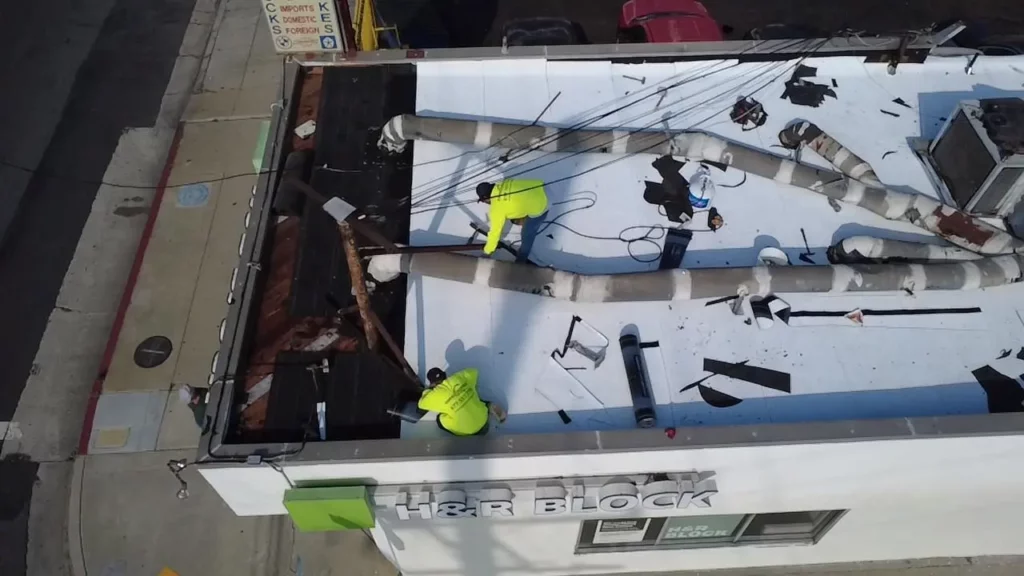
Commercial Roof Repair, Recover, or Replacement
Most commercial roof decisions come down to one of three choices:
- Repair fixes a defined problem: an open seam, a failed flashing at a curb or parapet, a split at a drain, or a damaged area of cap sheet. Commercial roof repair in Los Angeles is the right call when the rest of the roof is dry and has service life left.
- Recover puts a new roof or a coating over the existing one. It avoids a tear-off but adds weight and keeps the old roof underneath.
- Replacement removes the roof down to the deck. Damaged decking is replaced, insulation and drainage are corrected, and a new system goes on.
A recover is not always allowed. With limited exceptions, the California Building Code does not allow a recover over two or more existing roof coverings, over slate or tile, or over a water-soaked or deteriorated roof. Those roofs come off down to the deck. Before we price a recover, we make small test cuts to count the layers and check whether the insulation is wet.
Commercial roof replacement in Los Angeles also does not have to happen all at once. On a large building, the roof can be replaced in sections so tenants keep working, as our guide to phased roof replacement explains.
Price depends on the roof area; the number of layers that come off; deck repairs; insulation the energy code may require; drains, curbs, and penetrations; parapet and coping work; access; and any after-hours or phased scheduling. Every estimate is free and written, and our roof replacement cost guide explains how roofing is priced in Southern California.
Title 24 Cool Roof Rules and Permits for Commercial Reroofs
Since January 1, 2026, the 2025 Energy Code (Title 24, Part 6) has applied a cool roof rule to nonresidential reroofs. It is triggered when a project replaces, recovers, or recoats more than 2,000 square feet or more than half the roof area, whichever is less. A low-slope roof (a pitch below 2:12) then needs a CRRC-rated surface with minimum aged values of 0.63 for solar reflectance and 0.75 for thermal emittance, or an SRI of 75, in every climate zone.
Minor repairs, such as fixing a leak, are exempt, as is work on an unconditioned building (see the Energy Commission’s summary). A low-slope reroof can also bring insulation requirements, and apartment buildings follow the multifamily rules, which use the same trigger. Our guide to California cool roof requirements covers the exceptions, the climate zones, and the paperwork.
In the City of Los Angeles, a reroof needs a permit from LADBS, the city’s Department of Building and Safety. Its express permit bulletin covers two common commercial jobs with no plan check. One is a reroof in a Class A or B material lighter than 6 pounds per square foot, and the other is an approved coating applied to an existing roof. Other cities issue reroof permits through their own building departments, and Los Angeles County Public Works issues them in unincorporated areas and its contract cities. We pull the permit and schedule the inspections.
Working Around Tenants, Customers, and Business Hours
A commercial roof job happens over people who are working, shopping, or living in the building, so we settle these points with the owner or property manager first:
- Hours. Noisy tear-off and torch work can be scheduled for the hours that disrupt the business least.
- Notice. You get the dates and affected areas, so you can tell tenants which entrances, parking spaces, or loading docks will be busy.
- Rooftop equipment. HVAC units may need to be shut down, raised, or disconnected, so we coordinate with your mechanical contractor.
- Daily dry-in. Any section opened during the day is made watertight before the crew leaves.
Drains, Scuppers, Parapets, and Rooftop Equipment
Leaks on commercial roofs often start at an edge, a joint, or a penetration rather than in the middle of the roof. We check these details on every commercial job:
- Roof drains and scuppers. A drain that sits higher than the roof around it, or a scupper too small for the area it serves, leaves standing water. A reroof is the time to lower drain sumps, add tapered insulation, and enlarge or reline scuppers.
- Overflow drainage. Where parapets would trap water if the main drains clog, the California Building Code calls for secondary (emergency overflow) drains or scuppers, and a reroof cannot remove existing ones unless they are replaced.
- Parapets and coping. On a reroof, the membrane runs up the inside of the parapet and finishes under new coping or counterflashing, with the coping joints sealed.
- HVAC curbs and penetrations. Curbs, pipe supports, conduit, and sign brackets each need flashing tied into the membrane, and walkway pads keep service technicians from wearing a path through the roof.
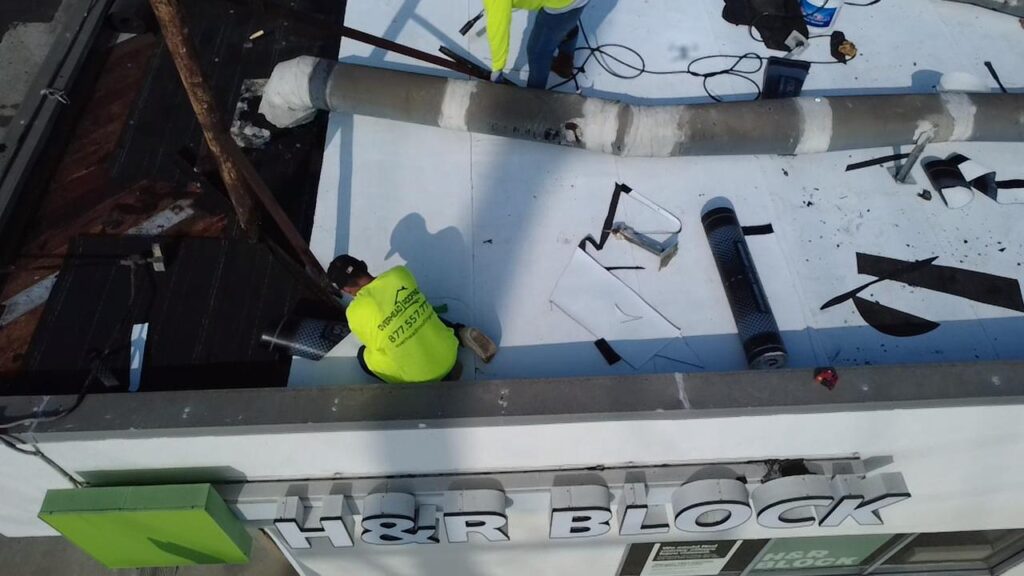
Records and Documentation for Owners, Managers, and Insurers
A roof file saves time when a leak comes back, a building sells, or an insurer asks questions. Keep these for each building:
- The reroof permit and its final inspection
- Product data and the CRRC label for any cool roof surface
- The contractor’s workmanship warranty
- Dated photos and written notes from each inspection and repair
When a storm damages the roof, the claim is the owner’s to make. Our part is the record: dated photos, an inspection report, and a written estimate your carrier can review, plus a meeting with the adjuster on site if you want one. We don’t file, negotiate, or settle claims, so check the policy and call the carrier about coverage.
Our Reviews
Posted on GoogleTrustindex verifies that the original source of the review is Google. I live in Alhambra and had a few broken tiles after a windstorm. William and Mike from Overhead Roofing Inc came highly recommended, and now I know why. They handled the repairs quickly and thoroughly, and even checked nearby spots without being asked. Sherry from the office made billing and follow-up a breeze. I’ll be using them again for a full re-roof in the futurePosted on GoogleTrustindex verifies that the original source of the review is Google. Great, thank youPosted on GoogleTrustindex verifies that the original source of the review is Google. Our office in Sierra Madre started having ceiling leaks. Overhead Roofing Inc sent Sean and Mike, who discovered the issue was actually with the parapet wall flashing. They fixed it and gave us solid maintenance recommendations. Tammi kept everything on time and within budget. Their knowledge and clarity made a huge difference.
Get a Commercial Roofing Estimate
Tell us about the building, the roof system, and what your tenants or staff are seeing. Call (877) 557-7778 or use the form below. Overhead Roofing is licensed, bonded, and insured (CSLB #1119699, C-39), and estimates are free.
Get Your Free Estimate
Please fill out the form below, or call: (877) 557-7778
Please fill out the form below, or call:
(877) 557-7778
Need Roof Repair or Replacement? Get a Free Estimate Today!
Don’t wait until a minor issue turns into a significant expense. At Overhead Roofing CA, we make it easy to get expert service fast with no pressure and no hidden fees. From routine roof maintenance to full tear-offs and installations, our team handles every project with precision, honesty, and care.
We specialize in helping LA homeowners and business owners protect their most valuable assets with dependable roofing solutions that last. Our licensed contractors are standing by, ready to inspect your roof, answer your questions, and provide a clear action plan all at no cost to you.
Residential roof repair & replacement
Commercial roofing inspections & upgrades
Emergency leak response & storm damage repair
Financing options available for every budget
Commercial Roofing Questions from LA Owners and Managers
How do I check a commercial roofing company's license in California?
Search the contractor’s name or license number on the Contractors State License Board (CSLB) website. Look for an active license with the C-39 Roofing classification, which covers products that seal, waterproof, and weatherproof structures. The record also lists the contractor’s bond and workers’ compensation insurance. Ask the commercial roofing contractors in Los Angeles you are comparing for their license numbers; ours is CSLB #1119699 (C-39).
Do you handle industrial roofing in Los Angeles?
Yes. Warehouses, distribution buildings, and light industrial plants usually have large low-slope roofs. The work follows the same approach as the rest of our commercial roofing in Los Angeles, with extra attention to drainage over long roof runs, skylights and exhaust fans, and scheduling around shifts and loading docks. Tell us about roof-mounted equipment or site safety rules when you request an estimate.
Does recoating a commercial roof count under California's cool roof rules?
It can. Under the Energy Code, recoating counts the same as replacing or recovering. Once a coating project covers more than half of the roof, or more than 2,000 square feet if that is less, the coating must be CRRC rated and meet the low-slope cool roof values. Recoating an existing coating for renewal or maintenance is exempt from the insulation requirements that can apply to a recover.
Who pays for roof repairs on a leased commercial building?
The lease decides. Under a triple net (NNN) lease, the tenant usually pays the building’s taxes, insurance, and maintenance, but many leases treat roof replacement differently from routine repairs. Read the roof and maintenance clauses, and ask your attorney or broker if they are unclear. Our written estimate can list repair items and replacement work separately to help sort out who pays.
How often should a commercial roof in Los Angeles be checked?
We suggest two visits a year: one in early fall, before the winter storms, and one in spring to see what they did. The fall visit matters most, since the bulk of the city’s rain falls between November and March. Add a check after a major storm and after any HVAC or solar work on the roof, since crews working on equipment can damage the membrane and flashings.
Serving All of Southern California
Choose your county to see the cities and roofing services near you.