
Overhead Roofing » TPO Roofing
TPO Roofing in Los Angeles
TPO roof installation and replacement on commercial buildings, apartments, and homes across Los Angeles County by a licensed C-39 roofing contractor. Estimates are free.
- Licensed, bonded & insured
- CSLB #1119699 (C-39)
- BBB Accredited, A rating
TPO Roofers for Commercial Buildings and Homes
TPO roofing in Los Angeles is a single-ply system: one layer of white thermoplastic polyolefin membrane, reinforced with a fabric scrim, fastened or glued over insulation, and welded with hot air at every seam. We install new TPO roofs and handle TPO roof replacement on commercial buildings, apartment buildings, and low-slope homes, either by tearing the old roof off or, where the code and the roof allow it, by installing the new membrane over it.
Overhead Roofing holds CSLB license #1119699 in the C-39 Roofing classification, and the license is active. Our team brings 25+ years of roofing experience. Our TPO roofers cover all of Los Angeles County, along with Orange and Ventura counties. Commercial TPO roofing in Los Angeles goes on warehouses, retail buildings, offices, and apartment buildings with large, simple roofs, and TPO also works on low-slope homes.
If a TPO roof is leaking now, our flat roof repair page covers seam, puncture, and flashing repairs. This page covers new TPO roofs and the replacement of old ones.
CSLB #1119699 (C-39)
Hot-air welded, no flame
Often 45, 60, or 80 mil
24/7: (877) 557-7778
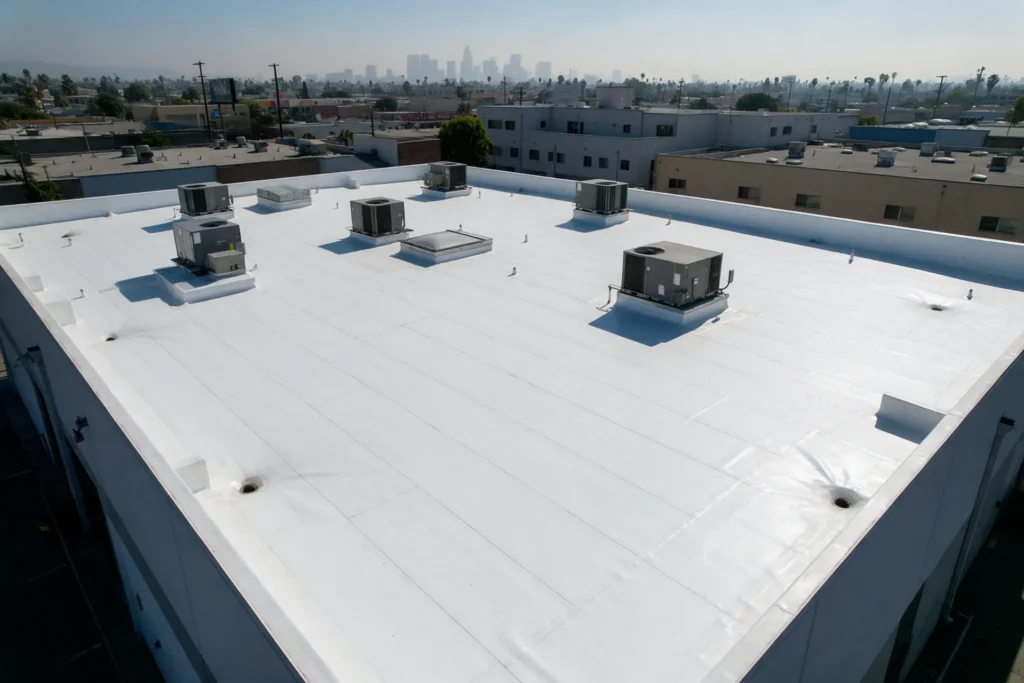
TPO Roof Replacement: Tear-Off or Recover
TPO roof replacement starts with one question: does the old roof have to come off, or can the new membrane go over it?
- Tear-off. The old roof and its insulation are removed down to the deck, bad decking is cut out and replaced, new insulation goes down, and the TPO goes on top. It costs more in labor and disposal, but the new roof starts on a dry, known base.
- Recover. The new TPO goes over the existing roof on a layer of new insulation or cover board. It skips the tear-off and the haul-away, but it adds weight, raises the roof surface, and leaves the old roof in place underneath.
California’s building code limits recovers. Tear-off is required when the roof already has two layers, when it is water-soaked or deteriorated, or when it is tile or slate, and our reroofing page explains those layer rules. Our estimate for a TPO roof replacement says which method we priced and why, based on small test cores that show how many layers are on the roof and whether the insulation is dry. Wet insulation comes out either way, because water trapped between the old roof and the new membrane keeps damaging the new insulation and the deck.
Because a recover raises the roof, we check the flashing height at walls and door thresholds, the edge metal, and the roof drains before pricing one. The drains have to be reset or extended so water still runs into them. A TPO reroof also needs a permit, issued by LADBS inside Los Angeles city limits and by the local building department in other cities; we pull it and book the inspections.
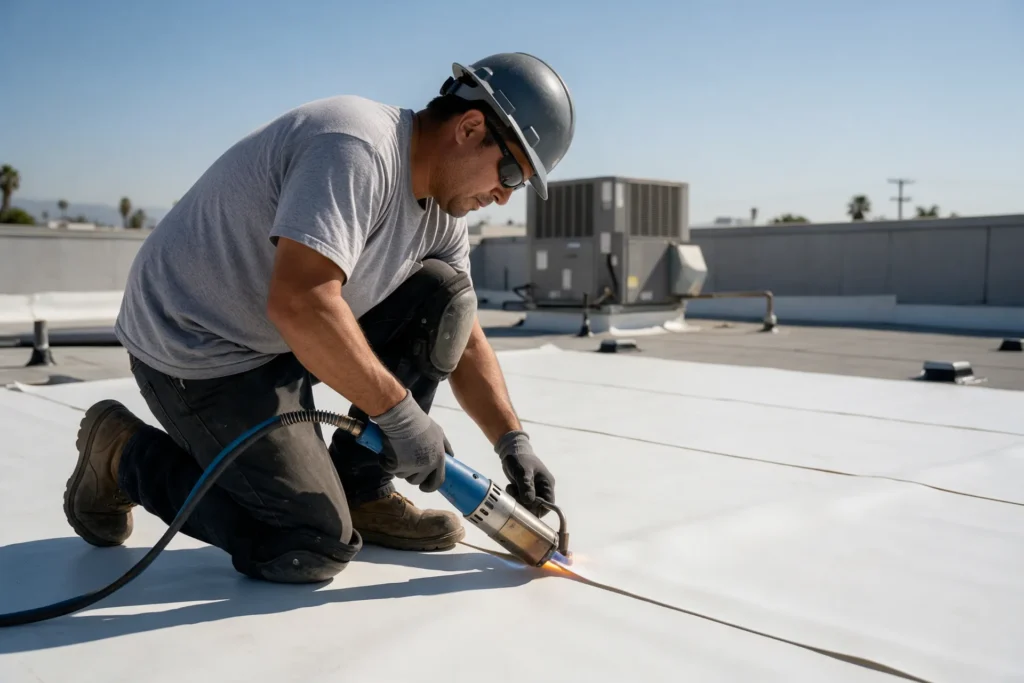
How a New TPO Roof Is Installed
TPO roof installation follows the membrane maker’s written specification at every step. Careful TPO roof installers pay the most attention to these five parts of the job:
Deck, insulation, and slope
The deck is checked and repaired first. Insulation board goes down next, and on a roof that holds water, tapered insulation can add slope toward the drains. On a nonresidential reroof, California’s energy code can also require added insulation, which raises the finished roof and changes the details at the edges and drains.
Fastened, adhered, or induction-welded
A mechanically attached system screws the membrane down with plates along each seam edge, and the next sheet laps over the fasteners. A fully adhered system glues the membrane to the insulation or cover board. An induction-welded system fastens plates through the insulation and bonds the membrane to them with heat, so no screw goes through the sheet. Wind uplift is strongest at a roof’s corners and edges, so each method adds fasteners or adhesive there, which matters on buildings exposed to Santa Ana winds.
Hot-air welded seams
Each sheet overlaps the next, and a hot-air welder melts the two layers into one. Once a weld cools, the crew runs a probe along the seam edge to find any gap, and any spot that catches is welded again. The weld is the waterproof joint, so its whole length gets checked.
Flashing at curbs, walls, and drains
Every HVAC curb, pipe, skylight, and wall gets its own TPO flashing welded to the field membrane, with molded pieces at pipes and corners. At parapets and stucco walls, the membrane runs up the wall and finishes under coping or counterflashing. At each roof drain, it is clamped into the drain body so water cannot run under it.
Edge metal and walkway pads
TPO-coated metal at the roof edge lets the membrane weld straight to the edge instead of relying on a sealant joint. Walkway pads welded along the route from the roof hatch to each HVAC unit protect the membrane from service traffic and dropped tools.
TPO vs. Torch-Down Modified Bitumen
Torch-down modified bitumen is the other common low-slope roof in Los Angeles, and owners often have both priced. This is how they compare:
| Feature | TPO | Torch-down modified bitumen |
|---|---|---|
| Layers | One reinforced membrane over insulation | A base sheet and a mineral-surfaced cap sheet |
| How seams are made | Welded with hot air | Heated with a propane torch and pressed down |
| Open flame on the roof | No | Yes; the fire code treats torch work as hot work |
| Surface | Smooth white membrane | Granulated cap sheet, often white or light gray |
| Foot traffic | Walkway pads on service routes | Takes foot traffic on the cap sheet |
| Good fit | Large, simple roofs with few penetrations | Smaller roofs with many vents, walls, and edges |
Torch-down is often the simpler roof on a house with many small details, and our flat roof contractors page compares the other flat systems. TPO makes more sense as a roof gets larger and simpler. If the existing roof is dry and sound, a silicone roof coating can renew its surface without a new membrane.
Call (877) 557-7778 any time, or use the form below. Office hours are Sunday through Friday, 8 a.m. to 5 p.m.
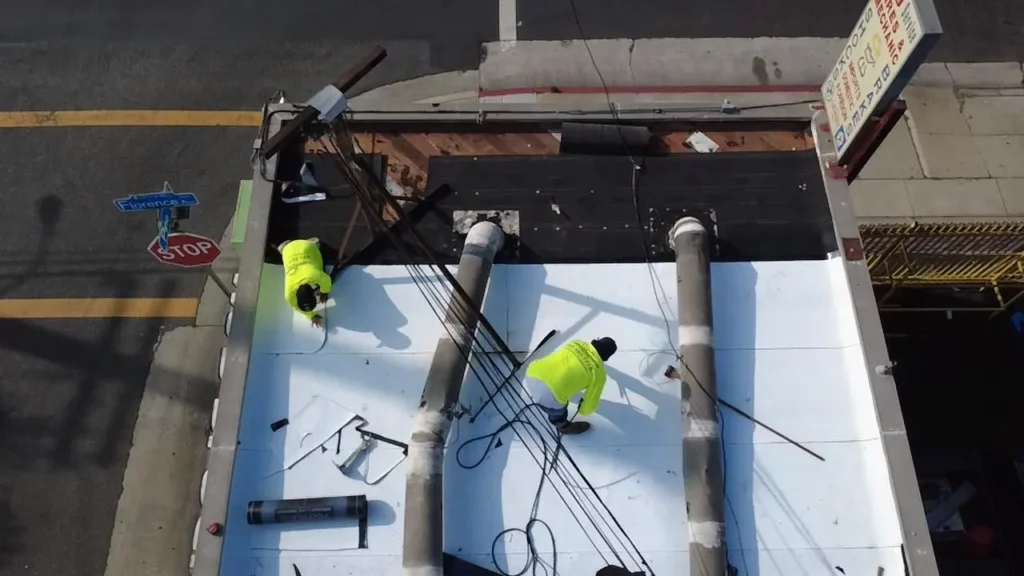
TPO Roofing on Los Angeles Homes
Residential TPO roofing makes sense on homes with a fairly large, simple low-slope roof: many mid-century houses, room additions with flat roofs, and detached garages. A few questions come up on almost every house:
- Color and glare. TPO is usually white. If neighbors look down on the roof from a hillside, ask which colors the maker offers and whether the color you pick still meets the cool roof rule when it applies.
- Walking on it. A TPO roof is not a deck. If you plan to use the roof as a patio, it needs a walkable waterproofing system instead.
- Solar panels. Every rack mount is a penetration that needs its own flashing welded into the membrane, so plan the layout before the roof goes on.
- Cool roof rules. A reroof covering over half of a home’s low-slope roof can bring in California’s cool roof requirement, and Los Angeles has a city rule that applies in every climate zone.
Choosing a TPO Membrane: Thickness, Backing, and Cool Roof Rating
TPO membranes come in several thicknesses, commonly 45, 60, and 80 mil (a mil is a thousandth of an inch). A thicker sheet puts more material over the reinforcing scrim, and it costs more. Ask each bidder which product and thickness they priced, so you are comparing the same roof.
Fleece-backed TPO has a felt-like backing on the underside. It is made for recover work and for adhered systems, and the backing adds puncture resistance.
If the reroof triggers California’s cool roof rule, the membrane has to be a product rated and labeled by the Cool Roof Rating Council (CRRC) that meets the required values. On commercial and apartment buildings, the size of the reroof sets the trigger, and our commercial roofing page explains it. You can look up any membrane in the CRRC Rated Products Directory.
What Sets the Price of a TPO Roof Replacement
We don’t publish prices, because two roofs of the same size can need very different work. These are the factors behind the price of a TPO roof replacement or a new installation:
- Roof area, and the number of curbs, pipes, skylights, and walls that need flashing
- Tear-off or recover, and how many layers come off
- Wet insulation or damaged decking found under the old roof
- Insulation the energy code requires on the reroof
- Membrane thickness, backing, and attachment method
- Drains, scuppers, and edge metal that need resetting or replacing
- Access, roof height, and getting material onto the roof
- Work scheduled around tenants or business hours
Estimates are free and written. Our roof replacement cost guide has published price ranges for Southern California, with their sources.
Our Reviews
Posted on GoogleTrustindex verifies that the original source of the review is Google. I live in Alhambra and had a few broken tiles after a windstorm. William and Mike from Overhead Roofing Inc came highly recommended, and now I know why. They handled the repairs quickly and thoroughly, and even checked nearby spots without being asked. Sherry from the office made billing and follow-up a breeze. I’ll be using them again for a full re-roof in the futurePosted on GoogleTrustindex verifies that the original source of the review is Google. Great, thank youPosted on GoogleTrustindex verifies that the original source of the review is Google. Our office in Sierra Madre started having ceiling leaks. Overhead Roofing Inc sent Sean and Mike, who discovered the issue was actually with the parapet wall flashing. They fixed it and gave us solid maintenance recommendations. Tammi kept everything on time and within budget. Their knowledge and clarity made a huge difference.
Get a Price on a TPO Roof
Send us the building’s address, the rough roof size, what is on the roof now, and any leaks or ponding you have seen. Call (877) 557-7778 or use the form. Estimates are free, and we are licensed, bonded, and insured under CSLB #1119699 (C-39).
Get Your Free Estimate
Please fill out the form below, or call: (877) 557-7778
Please fill out the form below, or call:
(877) 557-7778
Need Roof Repair or Replacement? Get a Free Estimate Today!
Don’t wait until a minor issue turns into a significant expense. At Overhead Roofing CA, we make it easy to get expert service fast with no pressure and no hidden fees. From routine roof maintenance to full tear-offs and installations, our team handles every project with precision, honesty, and care.
We specialize in helping LA homeowners and business owners protect their most valuable assets with dependable roofing solutions that last. Our licensed contractors are standing by, ready to inspect your roof, answer your questions, and provide a clear action plan all at no cost to you.
Residential roof repair & replacement
Commercial roofing inspections & upgrades
Emergency leak response & storm damage repair
Financing options available for every budget
TPO Roofing Questions From Owners and Homeowners
Can a new TPO roof go over my existing roof?
Sometimes. California’s building code allows a recover only over a roof that is dry and sound, and not over tile, slate, or a roof that already has two layers. Test cores show what is on the roof and whether the insulation is wet. If the roof qualifies, the TPO goes over a cover board or new insulation, and the drains and wall flashing are adjusted for the higher roof surface.
Do you install TPO on houses, or only on commercial buildings?
Both. On homes, TPO fits larger low-slope roofs with few vents, such as a mid-century house, a room addition, or a detached garage. On a small roof with many details, torch-down modified bitumen is often the simpler choice. Either way, a reroof of more than 50 percent of a low-slope roof may call for a cool roof product, so ask for the membrane’s CRRC rating.
What should I ask TPO roofing contractors before hiring one?
Ask for the license number and check it on the CSLB website for an active C-39 Roofing classification. Then ask which membrane, thickness, and attachment method they priced, whether the bid is a tear-off or a recover, how the seams are checked, whether the permit is included, and what the workmanship warranty covers. Our license is CSLB #1119699 (C-39).
Do you repair TPO roofs too?
Yes. Seam, puncture, and flashing repairs on TPO are covered on our flat roof repair page. If a TPO roof leaks in many places or has wet insulation over large areas, replacement or a recover usually makes more sense than a string of repairs, and we will tell you which after we see the roof.
Can a TPO roof be coated instead of replaced?
Sometimes. If the membrane is still attached, the seams are sound, and the insulation is dry, a coating can renew the surface, as long as its maker approves it over TPO. If the membrane is shrinking, splitting, or sitting on wet insulation, a coating only hides the problem.
Which areas do you serve for TPO roofing in and around Los Angeles?
TPO jobs take us all over Los Angeles County, from the San Fernando and San Gabriel valleys to the Gateway Cities and coastal cities, and into Orange and Ventura counties as well. The permit comes from the city where the building sits, and the cool roof rule depends on its climate zone.
Serving All of Southern California
Choose your county to see the cities and roofing services near you.