Reviewed by the Overhead Roofing team, CSLB #1119699. Updated November 2026.
Roof leaking in the rain? Here is what to do first: catch the water, move nearby belongings out of the way, cut power to any light or outlet near the drip, and take photos before you clean up. Stay off the roof while it is wet. Then call a licensed roofer to cover the leak and plan the repair, and call your insurance company if a storm caused the damage.
The steps below follow the order we suggest for the first hour. They are written for homes in Los Angeles County, where many roofs show their first leak of the season during the first heavy storms of winter.
Roof Leaking: What to Do in the First Hour
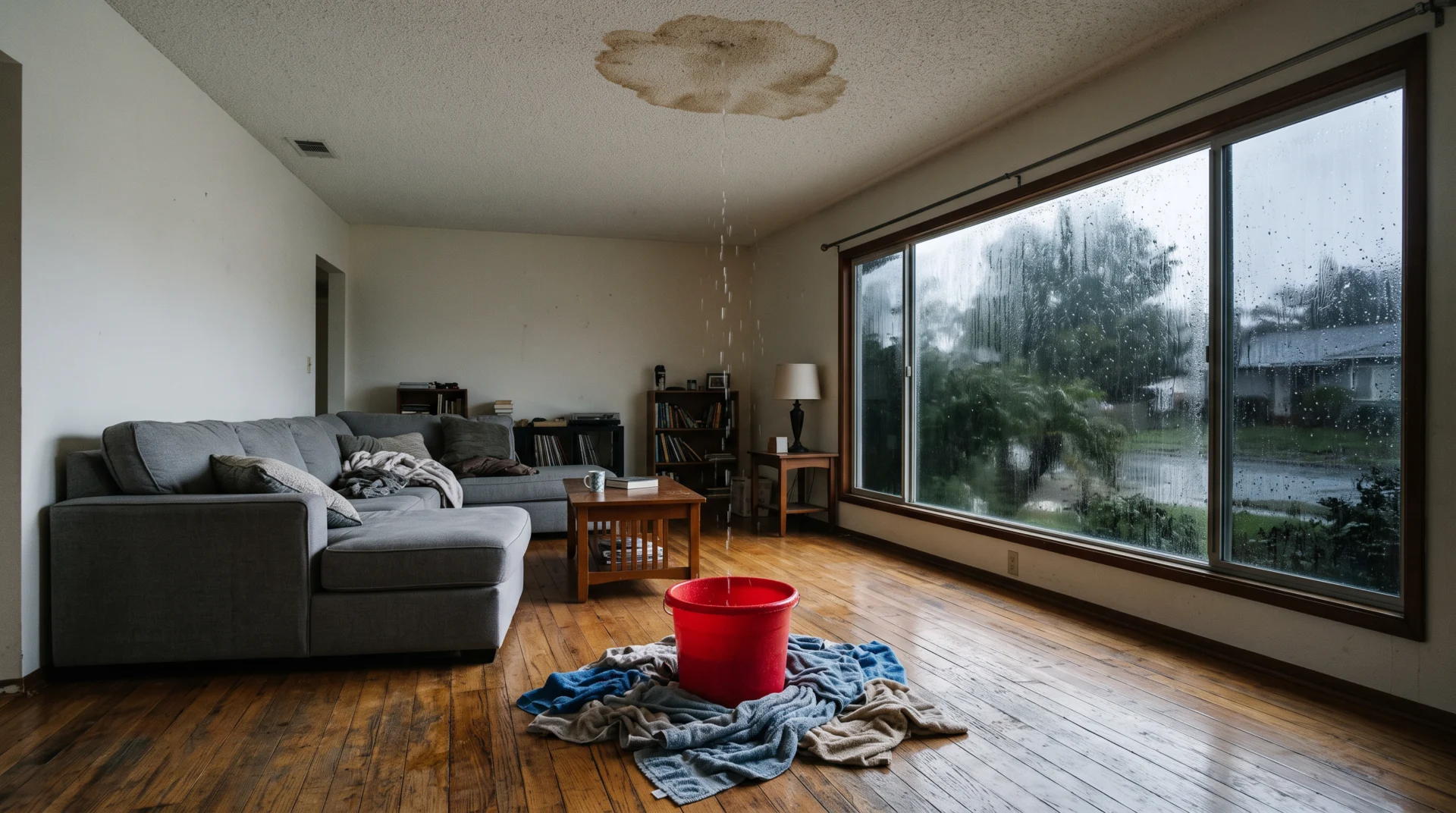
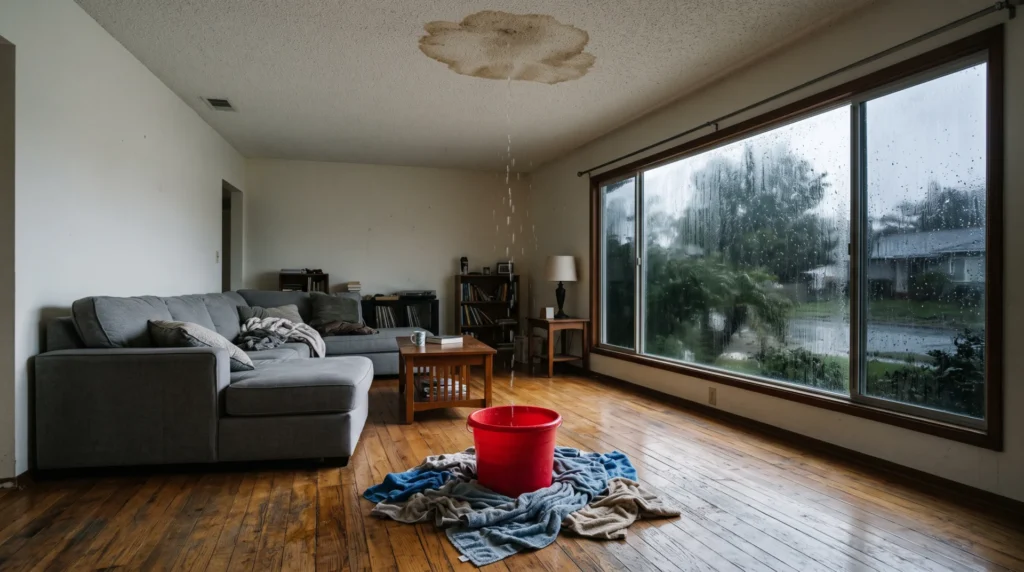
- Catch the water. Put a bucket, pot, or storage bin under each drip. Lay towels or plastic sheeting around it to protect the floor, and empty the container before it fills.
- Move your things. Pull furniture, rugs, electronics, and boxes out of the wet area. Cover anything you cannot move with plastic.
- Make the wiring safe. If water is coming through or near a ceiling light, fan, smoke detector, or outlet, switch off that circuit at the breaker panel, as long as you can reach the panel without standing in water. If water is near the panel itself, stay away from it and call an electrician.
- Drain a bulging ceiling on purpose. When water collects above drywall, the ceiling can sag and then give way all at once. Set a bucket under the lowest point of the bulge, stand to the side, and make a small hole with a screwdriver so the water drains into the bucket.
- Take photos and video. Record the ceiling, the walls, the floor, and everything that got wet before you clean up. Your phone keeps the date and time of each picture.
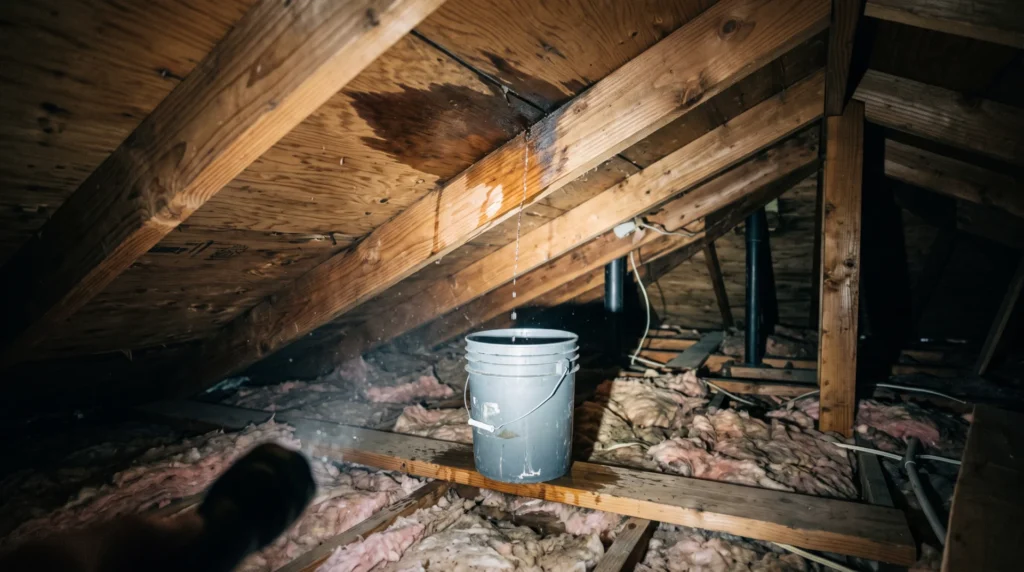
- Look in the attic, if it is safe. With a flashlight, look for wet wood, wet insulation, or a drip. Step only on the ceiling joists or on a board laid across them. Put a container under the drip and note where the water first shows up.
- Make the calls. Call a roofer for temporary protection and the repair. If wind, a falling branch, or another sudden event caused the leak, call your insurance company too.
Can You Fix a Roof Leak From the Inside?
Not permanently. From inside the house or the attic, you can catch the water and limit the damage, but the opening that lets the rain in is on the outside of the roof, so the repair has to be made there.
What you can do from the inside as a temporary roof leak fix:
- Put a container under the drip in the attic so the water stops reaching the ceiling.
- If water is running along a rafter, lay a strip of plastic or a board so it guides the water into the container.
- Pull soaked insulation off the ceiling drywall to take weight off the drywall and help it dry.
- Mark the wet spots on the rafters and the roof deck with tape or chalk. This saves time when the roofer looks for the entry point.
Sealant or roofing cement smeared on the underside of the roof deck rarely stops a leak. Water often enters several feet away from where it drips, travels along the underlayment or a rafter, and comes out at the lowest point. Our guide on how to trace a roof leak explains why the drip and the entry point are often in different places.
Why You Should Stay Off a Wet Roof
A roof is most dangerous to walk on during and right after rain. Wet shingles and tiles are slippery, and the edge of a two-story roof is high enough to cause serious injury in a fall.
- Tile roofs: clay and concrete tiles can crack under a person’s weight, which adds new openings for water.
- Shingle roofs: wet shingles and loose granules make footing unreliable, especially on steeper slopes.
- Flat roofs: standing water hides soft spots, open seams, and the edge of the roof.
If the roof needs a tarp, it should go on when the rain and wind ease, installed by a crew working from secured ladders with fall protection. See how temporary roof tarping and sealing works.
Who to Call for a Roof Leak
Call a licensed roofing contractor for the roof itself. In California, roofers are licensed by the Contractors State License Board (CSLB), and roofing is the C-39 classification. You can look up any roofer’s license number on the CSLB website before you hire them.
Not every ceiling stain is a roof problem. The timing of the leak tells you who to call:
| What you see | Likely source | Who to call |
|---|---|---|
| Ceiling leaking from rain, only during or right after a storm | Roof, flashing, skylight, gutters or roof drains | Roofer |
| Water at the top of a window or wall after wind-driven rain | Window or wall flashing, sometimes the roof edge | Roofer first; a window or stucco contractor if the roof checks out |
| A wet spot in dry weather | Plumbing, water heater, or an air conditioner drain line | Plumber or HVAC technician |
| Water below a bathroom or along a pipe | Supply or drain pipe | Plumber |
| Water near the electrical panel or wiring | Any of the above | Electrician first, after cutting the power if it is safe |
After a large storm, people sometimes go door to door offering roof work. Check the license first, and get the scope of work and the price in writing before anyone starts.
Overhead Roofing runs a 24/7 emergency line at (877) 557-7778. We are licensed, bonded, and insured under CSLB #1119699. Our emergency roof leak repair in Los Angeles page explains how a call is handled.
What Happens After You Call a Roofer
An emergency roof repair usually happens in two stages:
- Temporary protection. The crew stops the water with a tarp or temporary sealing over the leaking area, so the inside of the house can start to dry.
- The permanent repair. Once the roof is dry, the roofer finds the entry point and repairs it with matching materials.
Leaks in the first storms of the season most often start at:
- flashing around chimneys, vent pipes, skylights, and roof-to-wall joints (roof flashing repair)
- cracked or slipped tiles, and worn underlayment under tile roofs (tile roof repair)
- lifted or missing shingles after Santa Ana winds
- clogged drains and scuppers, standing water and open seams on flat roofs (flat roof repair)
- gutters and valleys packed with leaves, which push water under the roof edge
For the full range of urgent work, see emergency roof repairs and storm damage repair.
Roof Leaks and Insurance: What to Do Before You File
Insurance policies generally treat sudden damage, such as wind lifting shingles or a falling branch breaking tiles, differently from wear and missed maintenance. The wording of your own policy decides what is covered. The California Department of Insurance gives homeowners these steps after a loss:
- Make temporary repairs to prevent further damage, such as covering an opening in the roof with plastic sheeting.
- Take pictures of the damage and keep records of clean-up and repair costs.
- Do not make permanent repairs until the insurance adjuster has seen the damage.
The Department also notes that a policy may not cover further damage if reasonable steps were not taken to protect the property. Our guide to handling a roof insurance claim covers the claim itself, and insurance on an older roof explains how roof age affects coverage. This is general information, not insurance or legal advice.
How Much Does It Cost to Fix a Roof Leak?
It depends on what failed and how far the water got. Resealing the flashing around one vent pipe is a small job. Replacing the underlayment under a section of tile roof, or decking that rotted from a slow leak, is a larger one. Damage inside the house, such as drywall and insulation, is a separate cost from the roof repair.
We give a written price after we see the roof, because the same stain on a ceiling can come from very different problems above it. See how we approach roof repair.
Before the Next Storm
Most of what turns a small drip into a large leak can be checked before the rain: gutters and downspouts, flashing, cracked tiles, and roof drains. Use our El Niño roof inspection checklist to check your roof from the ground and from the attic, or book a roof inspection with us.
Roof Leak Questions
How do I stop my roof from leaking in heavy rain?
From inside, you can only contain it: catch the water, move your belongings, drain a bulging ceiling into a bucket, and cut power to wet fixtures. The leak itself is stopped from the outside, with a tarp or temporary sealing once the rain and wind ease. Do not climb onto a wet roof to do this yourself.
Does homeowners insurance cover roof leaks?
It depends on the cause and on your policy. Leaks from sudden damage, such as wind or a falling tree limb, are more likely to be covered than leaks from age and wear. Take photos, make temporary repairs to prevent further damage, and call your insurer before any permanent repair is made.
Is a roof leak an emergency?
Treat it as one if water is near wiring or light fixtures, if the ceiling is sagging, or if water is spreading across the ceiling or down a wall. A slow drip into a bucket can wait for daylight, but call a roofer the same day so the roof can be covered before the next rain.
Can I put a tarp on my roof myself?
We do not recommend it during rain or wind, on tile roofs, or on two-story houses. A tarp that is not fastened and weighted correctly can blow off and tear more of the roof. If you decide to do it after the storm, work from a secured ladder and never alone.
How fast does a roof leak cause mold?
The U.S. Environmental Protection Agency advises drying water-damaged areas and items within 24 to 48 hours to prevent mold growth. That is why wet insulation and drywall should be dried or removed quickly, even after the roof is covered.
Roof leaking now? Call Overhead Roofing at (877) 557-7778. Our emergency line is open 24/7, and our office hours are Sunday through Friday, 8 a.m. to 5 p.m.
Sources: California Department of Insurance, Residential Property Claims Guide, Don’t Get Scammed After a Disaster and Top Ten Tips for People Affected by Winter Storms; U.S. EPA, A Brief Guide to Mold, Moisture and Your Home; Contractors State License Board.