
Overhead Roofing » Drip Edge Installation
Drip Edge Installation in Los Angeles
Drip edge added to shingle, tile, and flat roofs by a licensed C-39 roofing contractor, CSLB #1119699, across Los Angeles County. Estimates are free.
- Licensed, bonded & insured
- CSLB #1119699 (C-39)
- BBB Accredited, A rating
What a Roof Drip Edge Does at the Eaves
Drip edge installation adds a strip of bent metal along the eaves and rakes of a roof so rainwater drips clear of the fascia instead of curling back under the roofing. The California Residential Code requires drip edge on shingle roofs, and we install it on new roofs, on reroofs, and on many existing roofs that were built without it.
Water running off a roof does not always fall straight down. Some of it clings to the edge, runs back underneath, and soaks the edge of the roof deck and the top of the fascia board. A roof drip edge carries that water past the fascia into the gutter and covers the gap where wind-driven rain gets in.
For drip edge that is rusted, bent, or loose, see drip edge replacement. This page covers adding drip edge where there is none.
Shingle roof eaves and rakes
At least 2 inches
No more than 12 in. apart
CSLB #1119699 (C-39)
How to Install Drip Edge at Eaves and Rakes
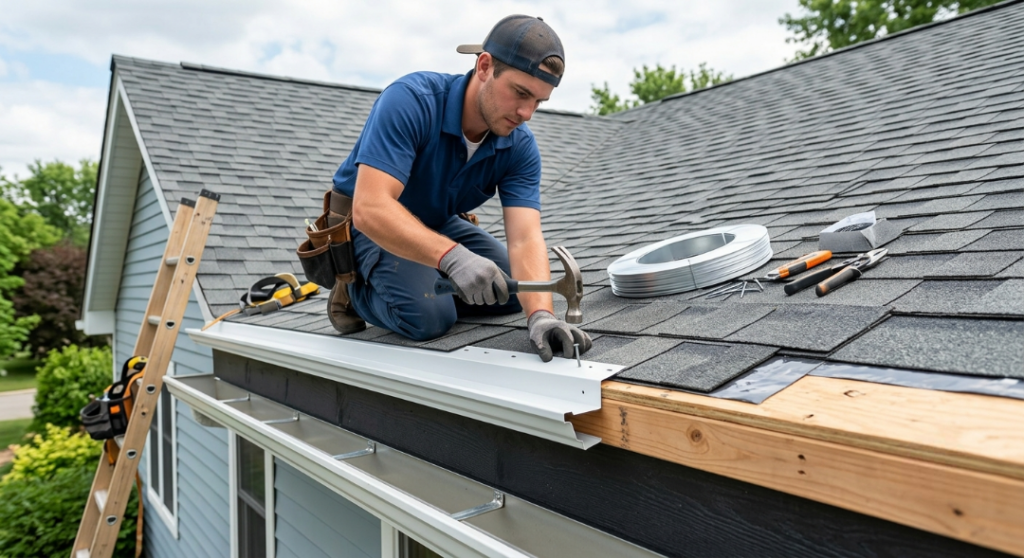
Section R905.2.8.5 of the 2025 California Residential Code sets the rules for a shingle roof:
- Eaves (the level, lower edges): drip edge goes on the bare deck, and the underlayment laps over it.
- Rakes (the sloped gable edges): the underlayment goes down first, and the drip edge covers it.
- Laps: at least 2 inches between pieces.
- Reach: at least 1/4 inch below the sheathing and 2 inches back onto the deck.
- Nails: no more than 12 inches apart.
Where an eave meets a rake, the rake piece laps over the eave piece, so water runs onto the eave metal instead of behind it.
Drip Edge Profiles, Metals, and Colors
| Profile | Shape | Where it fits |
|---|---|---|
| L-style (angle) | A plain right-angle bend | Simple edges; water can cling to the flat face |
| T-style or D-style | A flange, a face, and a bottom edge kicked out from the fascia | Most shingle roof eaves and rakes |
| Gutter apron | A longer face that reaches into the gutter | Eaves with gutters |
| Low-slope edge metal | A wide flange and face, sometimes with a raised lip | Flat roofs, with the membrane sealed over the flange |
Drip edge flashing comes in galvanized steel, aluminum, and copper, and painted metal can match the fascia or gutters. Salt air wears through bare galvanized coatings faster, so near the coast, painted steel or aluminum often makes more sense (see how ocean air affects roofs in Los Angeles). Keep copper from touching aluminum or galvanized steel.
Adding Drip Edge to an Existing Shingle Roof
Many homes can get drip edge for a shingle roof without a reroof:
Check the shingles and the edge first
We lift a corner of the first course to see whether the shingles are still flexible, and we look at the deck edge and the fascia. Brittle shingles crack when lifted, and rotted wood at the edge has to be replaced before any metal goes on.
Rake drip edge goes in first
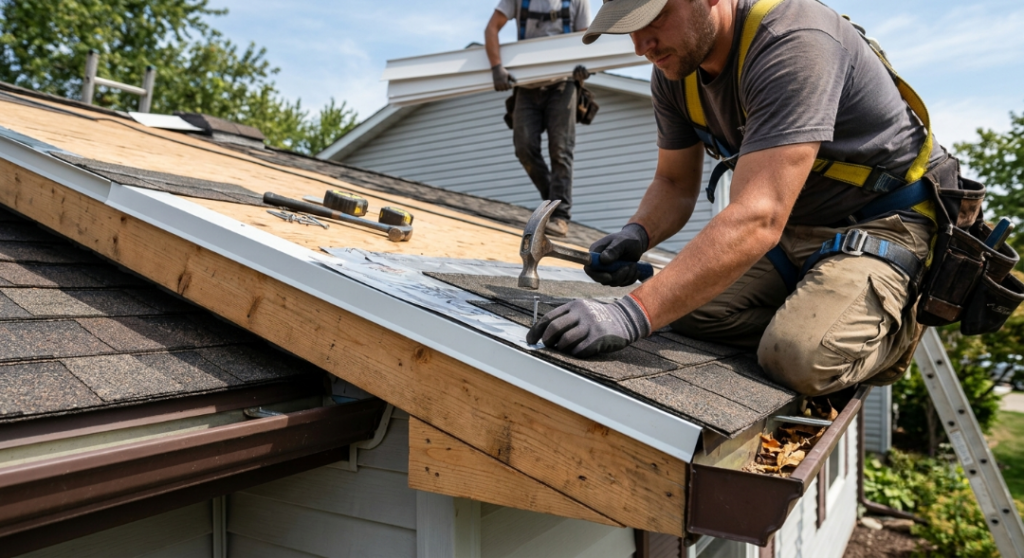
Because the code puts rake drip edge over the underlayment, the edge shingles only need to be lifted far enough to slide the metal in and nail it to the deck. The shingles then go back down over the flange and are sealed.
The eaves take more care
At the eaves, drip edge belongs under the underlayment, so the starter course and the underlayment edge are lifted and the metal goes onto bare deck. Underlayment that tears is patched. Every lifted shingle is then sealed down, so the edge is harder for a Santa Ana wind to lift.
When waiting for the reroof makes sense
If the shingles are near the end of their life, lifting them can break more than the drip edge saves. Drip edge is then better added with a new roof, in the right order with new underlayment, as our shingle roof installation page explains.
Call (877) 557-7778 any time, or use the form below. Office hours are Sunday through Friday, 8 a.m. to 5 p.m.
Drip Edge on Tile Roofs and Flat Roofs
The code’s drip edge rule is written for shingle roofs, but tile and flat roofs need metal edges too.
Tile roofs. Under clay or concrete tile, the waterproof layer is the underlayment, and edge metal protects its exposed edge. Adding edge metal to a tile roof means taking up the eave and rake tiles, then resetting them and replacing any that break, which overlaps with tile roof repair.
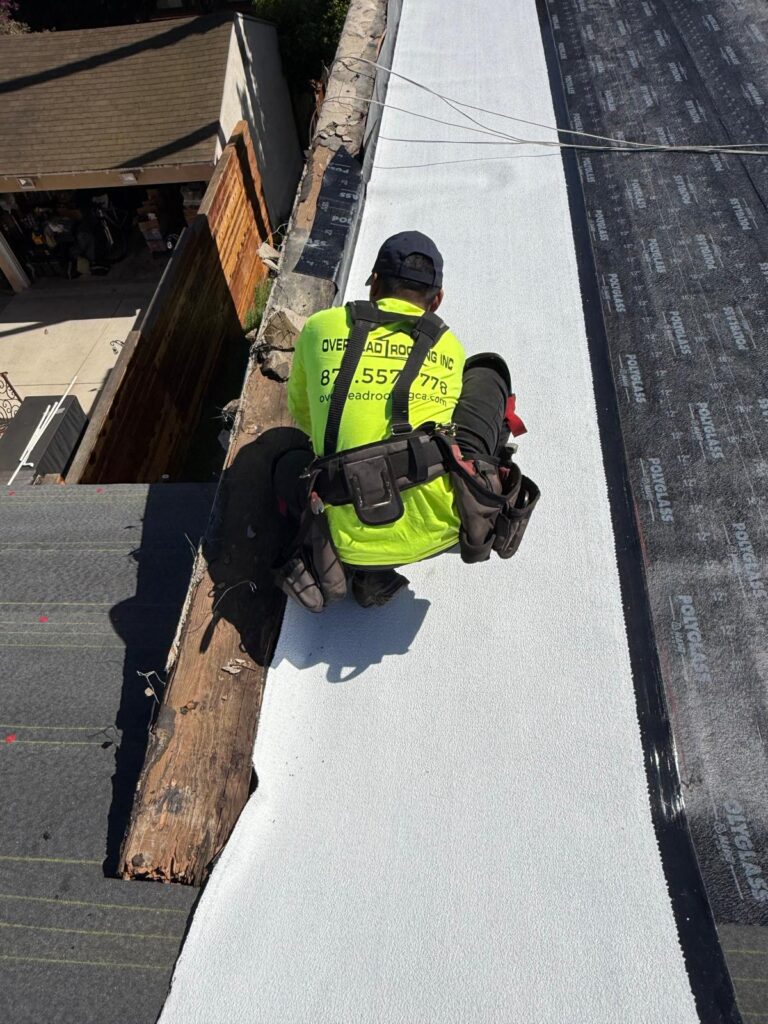
Flat roofs. A flat roof drip edge has a wide flange nailed over the base layers, and the membrane is sealed over it: a torch-down strip on modified bitumen, or a welded strip over TPO-coated metal. For commercial and apartment buildings, Section 1504.6 of the California Building Code adds a wind rule: the edge metal must be built to resist wind loads and tested under ANSI/SPRI ES-1.
Drip Edge Installation Cost Factors
We price drip edge after measuring the roof and don’t publish set prices. These factors move the number:
- Linear feet of eaves and rakes, plus the number of corners
- Roof type, since resetting tile takes longer than lifting shingles
- Roof height, pitch, and ladder access
- The metal, profile, and color you choose
- Gutters that must be loosened to fit the metal behind them
- Rotted fascia or deck edge found once the edge is open
On a new roof, drip edge is one line in the reroof estimate, and our roof cost guide explains what drives that price. For wall and chimney flashing, see roof flashing repair.
Our Reviews
Posted on GoogleTrustindex verifies that the original source of the review is Google. I live in Alhambra and had a few broken tiles after a windstorm. William and Mike from Overhead Roofing Inc came highly recommended, and now I know why. They handled the repairs quickly and thoroughly, and even checked nearby spots without being asked. Sherry from the office made billing and follow-up a breeze. I’ll be using them again for a full re-roof in the futurePosted on GoogleTrustindex verifies that the original source of the review is Google. Great, thank youPosted on GoogleTrustindex verifies that the original source of the review is Google. Our office in Sierra Madre started having ceiling leaks. Overhead Roofing Inc sent Sean and Mike, who discovered the issue was actually with the parapet wall flashing. They fixed it and gave us solid maintenance recommendations. Tammi kept everything on time and within budget. Their knowledge and clarity made a huge difference.
Get a Drip Edge Installation Estimate
Send us a few photos of the roof edge taken from the ground, tell us the roof type and whether you have gutters, and we’ll set up a visit. Call (877) 557-7778. Estimates are free, and Overhead Roofing is licensed, bonded, and insured (CSLB #1119699).
Get Your Free Estimate
Please fill out the form below, or call: (877) 557-7778
Please fill out the form below, or call:
(877) 557-7778
Need Roof Repair or Replacement? Get a Free Estimate Today!
Don’t wait until a minor issue turns into a significant expense. At Overhead Roofing CA, we make it easy to get expert service fast with no pressure and no hidden fees. From routine roof maintenance to full tear-offs and installations, our team handles every project with precision, honesty, and care.
We specialize in helping LA homeowners and business owners protect their most valuable assets with dependable roofing solutions that last. Our licensed contractors are standing by, ready to inspect your roof, answer your questions, and provide a clear action plan all at no cost to you.
Residential roof repair & replacement
Commercial roofing inspections & upgrades
Emergency leak response & storm damage repair
Financing options available for every budget
Drip Edge Installation Questions
Is drip edge required by code in California?
On shingle roofs, yes. Section R905.2.8.5 of the California Residential Code calls for drip edge along both the eaves and the rakes of an asphalt shingle roof, with rules for laps, nailing, and placement against the underlayment. It does not name tile or low-slope roofs, but metal edges are still standard on those roofs.
Can drip edge be added to an existing roof?
Often, yes. Drip edge installation on an existing shingle roof works when the shingles are still flexible: the edge shingles are lifted, the metal slides in, and the shingles are sealed down again. On a tile roof, the edge tiles have to be taken up and reset. Brittle shingles are a reason to wait for the reroof.
Does drip edge go over or under the underlayment?
It depends on the edge. Along the eaves, drip edge goes on first and the underlayment laps over it. Along the rakes, the underlayment goes on first and the drip edge covers it. Installed backward at the eaves, it lets water run behind the metal and onto the fascia.
Do I need drip edge if my house has gutters?
Yes. Without drip edge, runoff can cling to the roof edge and run down behind the gutter onto the fascia. A drip edge or gutter apron carries water past the fascia and into the gutter, and the rakes, which have no gutter, still need drip edge to protect the deck edge.
Does a flat roof need a drip edge?
Yes, at every edge. Where water drains off a flat roof, the edge metal works as a drip edge, and its flange, sealed under the membrane, also holds the membrane down. On commercial and apartment buildings, the building code requires that edge metal to be designed and tested for wind.
Serving All of Southern California
Choose your county to see the cities and roofing services near you.