
Overhead Roofing » Skylight Installation
Skylight Installation in Los Angeles
New, replacement, and tubular skylights framed and flashed into the roof by a licensed C-39 roofing contractor across Los Angeles County. Estimates are free.
- Licensed, bonded & insured
- CSLB #1119699 (C-39)
- BBB Accredited, A rating
Adding a Skylight or Replacing an Old One
Skylight installation covers three kinds of jobs: cutting a new skylight into the roof, replacing an old unit such as a cloudy plastic dome, and adding a tubular skylight that brings daylight down through the attic. Each one is roofing work as much as window work, because the skylight has to be framed into the roof and flashed into the roofing around it.
If your skylight leaks, start with skylight repair, since many leaks come from flashing that can be fixed without a new unit. Our C-39 Roofing license, CSLB #1119699, is active. Our team brings 25+ years of roofing experience.
Needed in many CA cities
4 in. above the roof, minimum
Wildfire glazing rules
CSLB #1119699 (C-39)
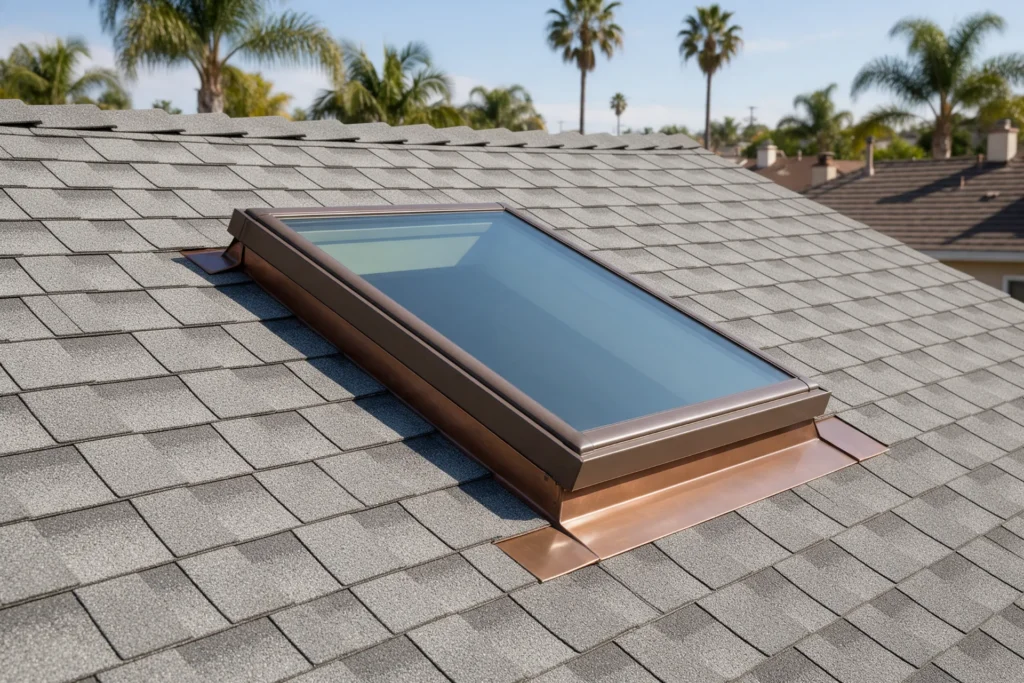
Choosing a New Skylight: Fixed, Venting, or Tubular
| Type | What it does | Good fit | Keep in mind |
|---|---|---|---|
| Fixed skylight | Lets in daylight; does not open | Living rooms, hallways, and vaulted ceilings | Needs a framed light shaft through any attic space |
| Venting skylight | Opens by hand or motor to let warm, moist air out | Bathrooms, kitchens, and upstairs rooms that trap heat | In fire hazard zones, an opening unit needs a fine noncombustible screen |
| Tubular skylight | A small roof dome, a reflective tube, and a ceiling diffuser | Closets, hallways, and small baths where a shaft will not fit | Less light than a full skylight, and no view of the sky |
Under the California Building Code, unit and tubular skylights must be tested and labeled to the AAMA/WDMA/CSA 101/I.S.2/A440 standard, so ask to see that label. The Energy Code also caps heat loss (U-factor) and solar heat gain (SHGC), and the rated values are on the unit’s NFRC label.
Skylight Replacement for Old Plastic Domes
Many Los Angeles homes still have acrylic dome skylights, often called bubble skylights. Once a dome turns yellow and brittle or cracks, the fix is a new unit, and bubble skylight replacement is a good time to switch to glass, add a venting unit, or move to a tubular skylight. The options depend on the curb the old dome sits on:
- Same-size swap. If the curb is sound, a new unit sized to that curb is the simplest replacement.
- Rebuilt curb. If the curb is rotted, too low, or the wrong size, it is rebuilt and reflashed before the new unit goes on.
- New size. Making the opening bigger or smaller changes the framing, which brings in the permit and framing rules below.
A replacement skylight has to meet the Energy Code’s U-factor and SHGC limits too, so check the rated values before choosing a unit to match the old one.
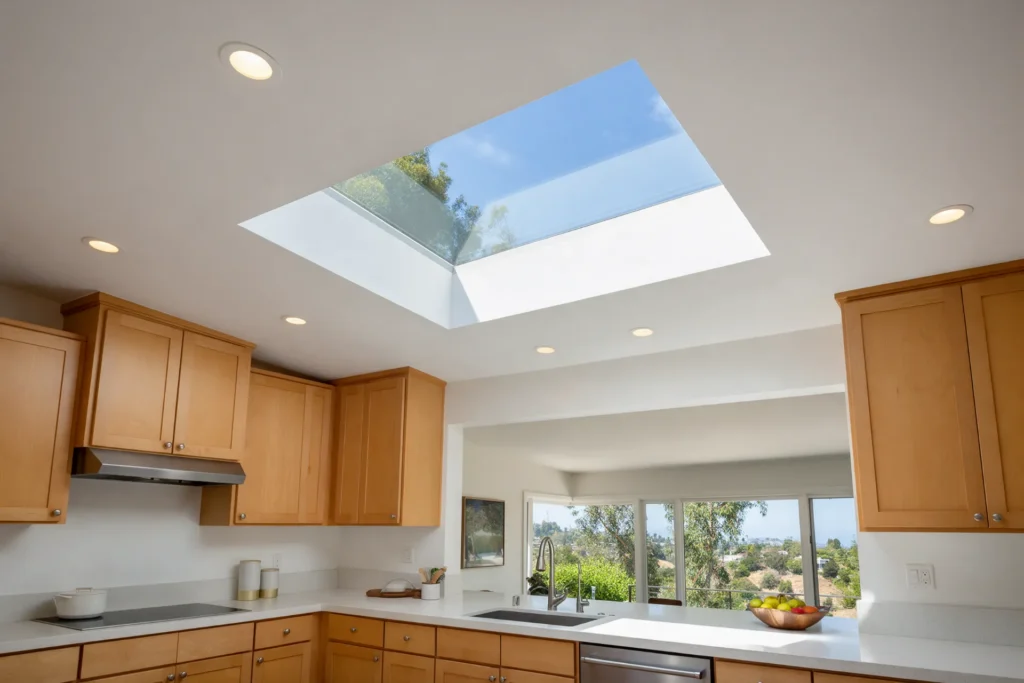
Framing, Permits, and Wildfire Rules for a New Skylight Opening
Framing. The simplest new skylight fits between two existing rafters. A wider unit means cutting a rafter, and building departments typically call for doubled rafters beside the opening. Engineered trusses are different: they are not cut without details and calculations from a licensed engineer.
Permits. California cities commonly require a building permit to add or replace a skylight, tubular skylights included, with a framing inspection when the framing changes. In the City of Los Angeles, LADBS’s express permit list covers reroofing but not skylights, so a new opening may need plan review. Elsewhere, the permit comes from the city’s building department, or from LA County Public Works for unincorporated communities.
Fire hazard zones. Homes inside the fire zones mapped under the California Wildland-Urban Interface Code must follow its rules, which call for skylights with multipane glazing and at least one tempered pane (or another approved option) and a noncombustible screen on opening units. You can look up your address on the State Fire Marshal’s zone map.
Call (877) 557-7778 any time, or use the form below. Office hours are Sunday through Friday, 8 a.m. to 5 p.m.
How a New Skylight Goes Into the Roof
Plan the spot from the attic
Before anything is cut, we check the attic for rafters, wiring, ducts, and vent pipes, and line the opening up with the room below. On a roof with no attic, such as a flat roof or a cathedral ceiling, the opening is located from inside and confirmed from the roof.
Open the roof and frame it
The roofing around the opening comes off, the deck is cut, and the opening is framed. Many units mount on a curb. Below a 3-in-12 pitch, the code wants the curb to stand at least 4 inches above the roof surface, unless the skylight maker’s instructions allow a lower one.
Flash it into the roofing
Underlayment is turned up around the curb or frame, and flashing goes on from the bottom up: an apron at the downhill side, step flashing woven with the shingles along the sides, and head flashing at the top. On tile, the flashing ties into the underlayment, which is the waterproof layer.
Build the light shaft
A fixed or venting skylight needs a framed, insulated, and drywalled shaft between the roof and the ceiling. That part is interior carpentry rather than roofing, so the estimate should say who builds and finishes it. Tubular skylight installation is simpler, since the tube runs through the attic to the ceiling diffuser.
Skylight Installation Cost Factors
We price each skylight after seeing the roof and the room below. These factors set the price:
- The type and size of skylight, and the glazing you choose
- A new opening versus a replacement on an existing curb
- The roofing, since tile has to be taken up and reset around the unit
- Framing changes, and any engineering a truss roof needs
- The length and finish of the light shaft
- Permit and inspection requirements in your city
If you are planning a reroof, add the skylight to the same job so its flashing goes on with the new roofing. For roofing price ranges from public sources, see our roof cost guide; for flashing at walls and chimneys, see roof flashing repair.
Our Reviews
Posted on GoogleTrustindex verifies that the original source of the review is Google. I live in Alhambra and had a few broken tiles after a windstorm. William and Mike from Overhead Roofing Inc came highly recommended, and now I know why. They handled the repairs quickly and thoroughly, and even checked nearby spots without being asked. Sherry from the office made billing and follow-up a breeze. I’ll be using them again for a full re-roof in the futurePosted on GoogleTrustindex verifies that the original source of the review is Google. Great, thank youPosted on GoogleTrustindex verifies that the original source of the review is Google. Our office in Sierra Madre started having ceiling leaks. Overhead Roofing Inc sent Sean and Mike, who discovered the issue was actually with the parapet wall flashing. They fixed it and gave us solid maintenance recommendations. Tammi kept everything on time and within budget. Their knowledge and clarity made a huge difference.
Get a Skylight Installation Estimate
Tell us the room and the roof type, say if the skylight is new or a replacement, and send photos of the ceiling and the roof if you can. Call (877) 557-7778. The estimate is free. We hold CSLB license #1119699 and are bonded and insured.
Get Your Free Estimate
Please fill out the form below, or call: (877) 557-7778
Please fill out the form below, or call:
(877) 557-7778
Need Roof Repair or Replacement? Get a Free Estimate Today!
Don’t wait until a minor issue turns into a significant expense. At Overhead Roofing CA, we make it easy to get expert service fast with no pressure and no hidden fees. From routine roof maintenance to full tear-offs and installations, our team handles every project with precision, honesty, and care.
We specialize in helping LA homeowners and business owners protect their most valuable assets with dependable roofing solutions that last. Our licensed contractors are standing by, ready to inspect your roof, answer your questions, and provide a clear action plan all at no cost to you.
Residential roof repair & replacement
Commercial roofing inspections & upgrades
Emergency leak response & storm damage repair
Financing options available for every budget
Skylight Installation Questions
Do I need a permit to install a skylight?
Plan on one. California cities commonly require a building permit to add or replace a skylight, tubular skylights included, and a new opening that changes the framing usually needs a framing inspection. In the City of Los Angeles, skylights are not on LADBS’s express permit list. We tell you what your city requires before your skylight installation is scheduled.
What is the difference between a sun tunnel, a solar tube, and a tubular skylight?
They are the same kind of product. Sun tunnel and solar tube are names manufacturers made popular, and building codes call it a tubular daylighting device. A small dome on the roof collects daylight, a tube with a mirror-like lining carries it through the attic, and a diffuser spreads it across the ceiling. It brings in light, but not a view.
Can you install a skylight on a flat roof?
Yes. On a low-slope roof the skylight goes on a raised curb, at least 4 inches tall under the code unless the maker’s instructions allow less, and the membrane runs up the curb and under the counterflashing. Choose a unit its manufacturer approves for that slope, and plan the curb height before the roofing goes on.
Will a new skylight make the room too hot?
It can if the unit or the spot is wrong. Skylights on south- and west-facing slopes get the most sun, and a venting unit lets hot air out. The Energy Code limits how much solar heat new skylights let in, and shades or a tubular skylight also help.
Can an old bubble skylight be replaced without changing the opening?
Usually. If the curb is sound and a new unit is made in that size, the old dome comes off, the curb is reflashed, and the new unit goes on. If the curb is rotted or too low, it is rebuilt first. Moving to a different size means new framing, which brings in the permit and inspection steps.
Serving All of Southern California
Choose your county to see the cities and roofing services near you.